In a data center, downtime is measured in minutes, and the outcome is an SLA breach and compensation. In these facilities, protection is a matter of staying online before it's a matter of protecting equipment.
Why Is This So Critical?
A data center is, by definition, designed to run without interruption. Redundancy architectures such as N+1 and 2N exist so that a single device failing doesn't stop the service. But a lightning-induced surge can affect more than one redundant line at the same time — which invalidates the whole premise of redundancy.
What makes protection genuinely difficult in these facilities is that the systems depend on one another. If the cooling system (chiller, CRAC/CRAH) goes down, servers shut down from heat within minutes — a consequence just as damaging as a power outage. A surge on the UPS or generator lines can disable the very backup system that's supposed to kick in at that exact moment.
Colocation (multi-tenant) facilities also face an isolation problem: a fault in one tenant's equipment must not affect other tenants through the shared infrastructure. This makes staging protection across panels a requirement, not an option.
Downtime = SLA Breach
Falling short of the uptime commitment means contractual penalties and lost customers. Downtime converts directly into cost.
Dependence on the Cooling System
A fault in the chiller or CRAC/CRAH system can bring servers down independently of any power interruption.
Multi-Tenant Risk
In colocation facilities, a fault at one tenant must not propagate to others through the shared infrastructure.
High-Density Electronics
Rising power density per rack means low-voltage-withstand, sensitive switching and processing hardware.
Where Is Protection Installed on Site?
In a data center, protection is built as a staged chain running from the substation down to the end device at rack level. The cooling, BMS, and telecom lines are as much a part of this chain as the power path itself.
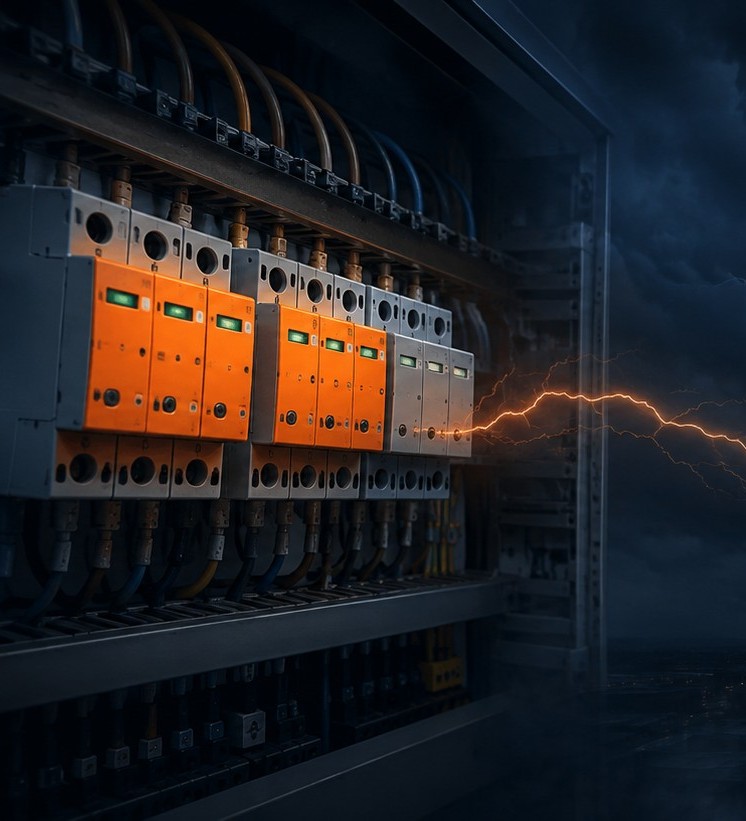
The first stop for the energy entering the facility. If the building has external lightning protection, a Type 1 SPD is mandatory here. At this point, where continuity is critical, Strikesorb technology is preferred — it doesn't blow a fuse after a fault and doesn't require a power interruption to swap out a module.
The UPS input and output, the generator automatic transfer switch (ATS) panel, and battery rooms each need their own protection. A surge disabling the backup system at the exact moment the grid drops out is one of the most costly scenarios possible.
The residual voltage passing through from the main board is limited at the PDU and rack panels by a Type 2 device. In facilities with redundant power feeds (A/B paths), both lines need their own separate protection — protecting only one leaves the redundancy one-sided.
Models with common-mode protection add an extra layer of safety exactly at the point where processor and switching cards are most sensitive.
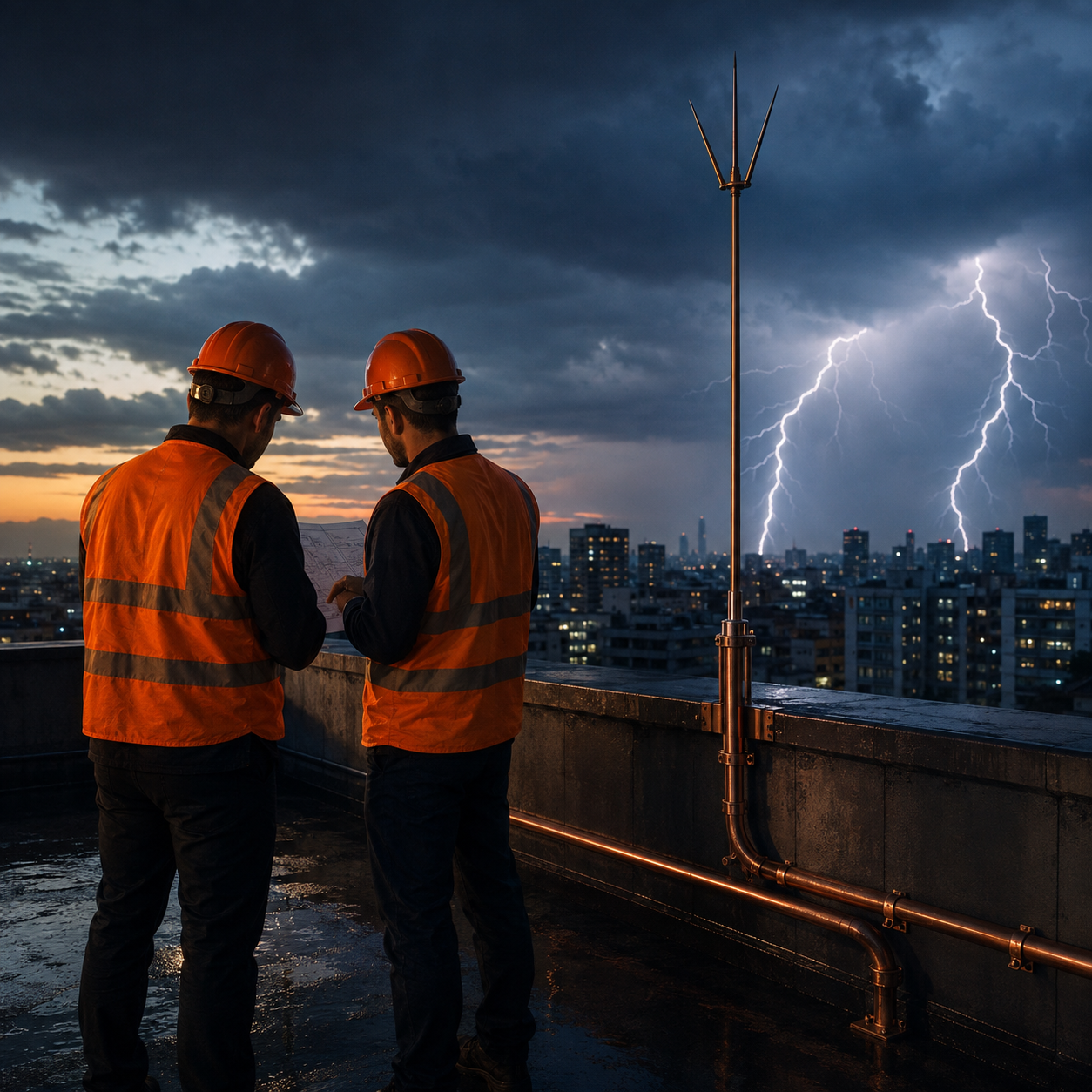
The cooling system is just as critical as the power supply — if it stops, servers shut down from heat within minutes. Chiller control cards, CRAC/CRAH units, and BMS lines are typically located on the roof or outdoors, which leaves them exposed to both induction and a direct strike.
Fibre lines are largely immune to electromagnetic induction, but the copper telecom lines entering the facility (carrier circuits, backup internet connections) and the internal copper structured cabling must not be left unprotected. A surge arriving on these lines can reach the switching hardware on the network backbone directly.
Rack cabinets, cable trays, raised-floor construction, and IT equipment must all be bonded to a common equipotential busbar system — this matters as much for electrostatic discharge (ESD) as it does for lightning protection.
If nobody notices an SPD reaching the end of its service life, the facility keeps running unprotected. In a facility with an SLA commitment, that isn't an acceptable risk — monitoring units carry protection status into the central monitoring system (BMS/NMS).
Featured Solutions for Data Centers
Strikesorb and Rayvoss
With no fuse and no thermal disconnector, they continue to provide protection after successive strikes, and swapping a module does not require cutting power. This is the decisive property in facilities where the uptime commitment can never be breached.
Protection Status Monitoring
Knowing an SPD has reached the end of its service life, without having to visit the site, is part of SLA reporting. Monitoring units carry protection status into the central monitoring system (BMS/NMS), so you know instantly which panel needs attention.
Line Protection
Dedicated, in some cases custom, protection solutions for carrier circuits, BMS lines, and internal copper cabling. Protecting the power side alone is not enough — data lines need their own protection stage.
How We Proceed for Your Facility
- Facility and criticality analysis The redundancy architecture (N, N+1, 2N), single-tenant or colocation structure, and the power chain are mapped out.
- Risk assessment and protection level Risk is calculated under TS EN / IEC 62305-2; the loss-of-service (R2) component carries particular weight for this facility type.
- Coordinated design of the power chain Staged protection from the substation through the UPS, PDU, and rack level is planned as a single, coherent whole.
- Installation without downtime Installation is scheduled around the live system's operating calendar, taking redundant lines out of service one at a time.
- Measurement, reporting, and continuous monitoring setup Earthing resistance and continuity measurements are reported, and protection status is monitored continuously in line with your SLA.
Let's Draw Up a Protection Plan for Your Data Center
Let's identify together where your power chain is at risk. Contact us for a site survey and a preliminary assessment.