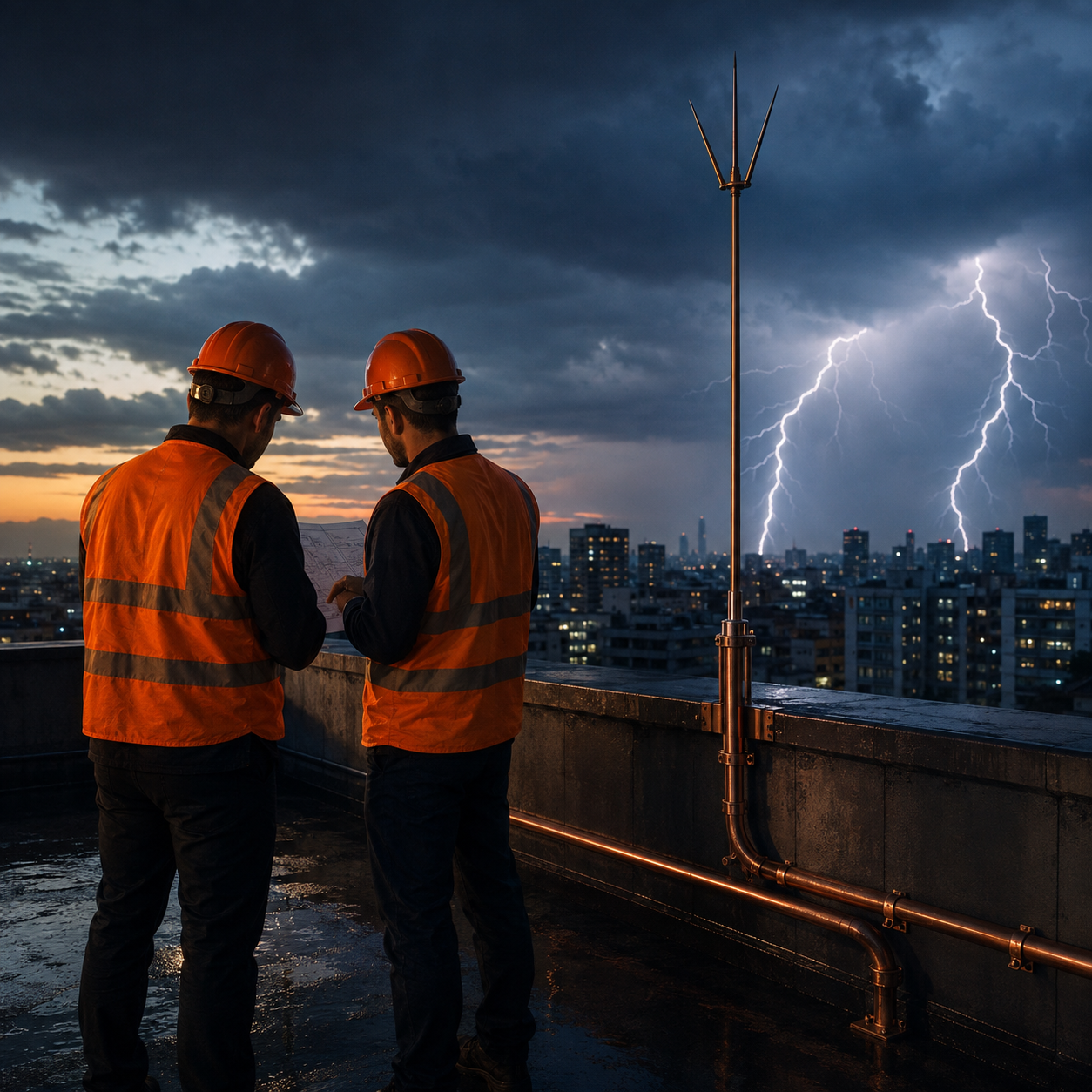
In most facilities, the cost of a single hour of production downtime exceeds the entire lightning protection investment. In industrial facilities, protection is not a matter of compliance — it is a matter of production continuity.
What Does Lightning Actually Hit in an Industrial Facility?
A modern production facility is far more sensitive than it was twenty years ago. Relay-based control panels have given way to PLCs, direct-on-line motors to drives, mechanical gauges to sensors and HMI screens. These devices make production more efficient — but their surge withstand is far lower than what they replaced.
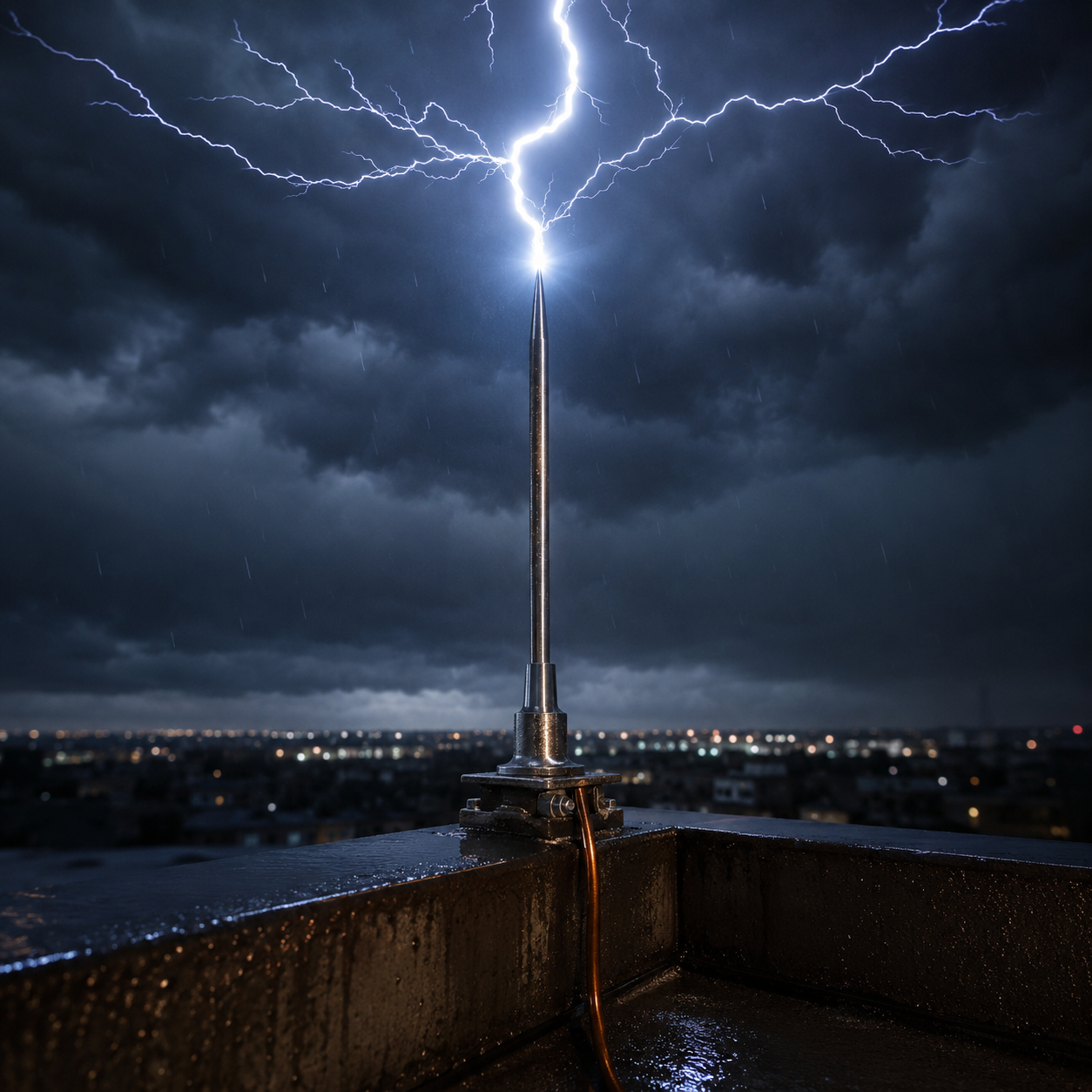
What causes the damage, moreover, is often not a direct strike on the facility itself. The voltage induced along long cable runs by a strike landing a few hundred metres away is more than enough to burn out a PLC input card. Industrial facilities have long cable routes — and the risk of induction rises with them.
Production Downtime
A single failed control card can stop the line. Sourcing the spare part can take days, during which the line stays down.
Automation Damage
PLCs, drives, sensors and HMIs all run on low-voltage electronics with low surge withstand thresholds.
Loss of Data and Measurement
An outage in SCADA, energy monitoring or quality-recording systems breaks the traceability chain.
Fire and Safety
A wrongly selected or end-of-life protection device can become a source of overheating and fire inside the panel.
Where Is Protection Installed in a Facility?
Lightning protection is not installed at a single point — it is built up in stages. Each stage brings the residual voltage passing through from the previous one down to a level the next device can withstand.
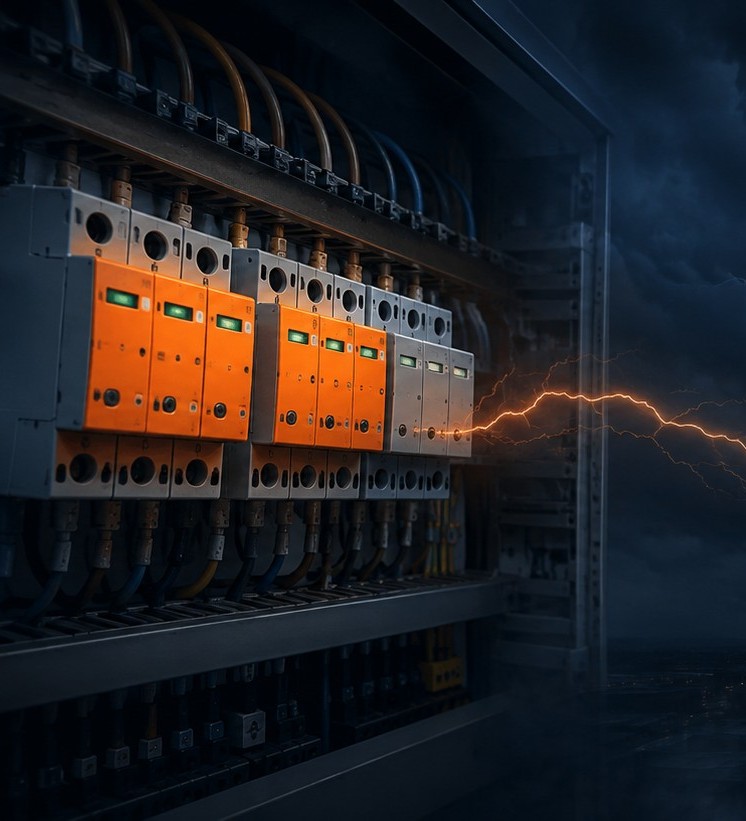
The first stop for the energy entering the facility. If the structure has an external lightning protection system, a Type 1 SPD is mandatory here — it must be able to carry a portion of the direct lightning current. In facilities where continuity is critical, Strikesorb technology — with no fuse and no thermal disconnector — is preferred.
DIN-rail solutions fall short on high-current busbar systems. What's needed are products mounted directly on the busbar with a high short-circuit withstand rating. Here, keeping the connecting-conductor length short has a direct effect on the protection level (Up).
Every machine panel on the production line is its own point of protection. The residual voltage passing through from the main board is limited here by a Type 2 device. Panels housing a motor drive and a control card benefit from additional common-mode protection.
This is the point most often overlooked in industry. Protecting the power line means nothing against a surge arriving on the signal line. 4–20 mA measurement loops, Profibus and Modbus lines, and encoder and sensor cables each require their own protection devices.
An SPD is only ever as good as the earthing system behind it. Without equipotential bonding across the facility, protection devices cannot do their job. And if an SPD's end of life goes unnoticed, the facility keeps running unprotected — monitoring devices remove this blind spot.
Featured Solutions for Industry
Strikesorb Technology
With no fuse and no thermal disconnector, it requires no power interruption or module replacement after a fault. It continues to provide protection even after successive strikes — built for facilities where production cannot afford to stop.
Rayvoss Series
Combines Strikesorb modules, the enclosure, monitoring and connection components into a single system. Suited to facilities that want a ready-made, tested protection solution without any additional panel design work.
ProTec DIN-Rail Series
Modular, DIN-rail-mounted solutions spanning Type 1 through Type 2. Can be added to existing panels after the fact, with fast module replacement.
How We Proceed for Your Facility
- Site survey and risk assessment The facility's location, structure, panel architecture and automation infrastructure are examined; the protection level is determined under TS EN / IEC 62305-2.
- Staged protection design A coordinated protection plan is drawn up for the main board, sub-distribution boards, machine panels and signal lines.
- Product selection and supply The type, capacity and configuration suited to each point are determined and sourced from the Raycap product range.
- Installation and commissioning The installation is planned and carried out without disrupting your production schedule.
- Measurement, reporting and periodic inspection Earthing resistance and continuity measurements are taken and reported; a periodic inspection programme is then set up.
Let's Draw Up a Protection Plan for Your Facility
Let's identify together where your production line is at risk. Contact us for a site survey and a preliminary assessment.