ProLEC Basic
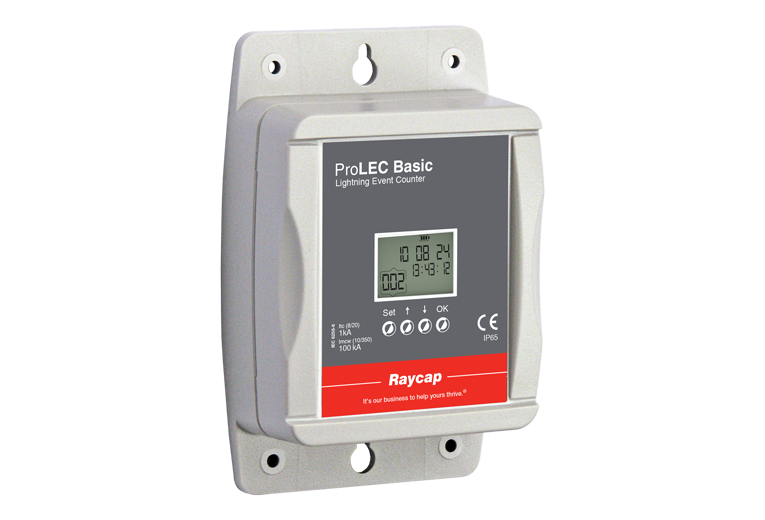
Raycap ProLEC Basic is a fundamental lightning current sensor that detects and records lightning discharges passing through the down-conductor. It can measure and withstand current up to 100 kA (10/350 µs). When installed on the exterior of a building or structure, it provides critical information about the frequency, date, and time of atmospheric discharges affecting the structure — allowing for timely repairs or preventive measures. Features an LCD screen, contact-less sensor, IP 65 protection, and IEC 62561-6 compliance.
The fundamental question that arises after a lightning protection system is installed is: Did the facility actually take a lightning strike, and if so, how many times and with what intensity? Without this information, it is not possible to determine when the system should be inspected — a lightning strike may have degraded the down-conductor, clamps, or grounding connections without leaving visible damage.
ProLEC Basic fills this gap. The device detects lightning current passing through the down-conductor and records the event. Its measurement and withstand capacity is 100 kA (10/350 µs) — meaning it is designed to withstand the full energy of direct lightning strikes.
The LCD screen displays the number of lightning strikes and the hour, minute, and date of each event. Buttons on the device allow for time/date setting and viewing the event log. It records up to 999 events.
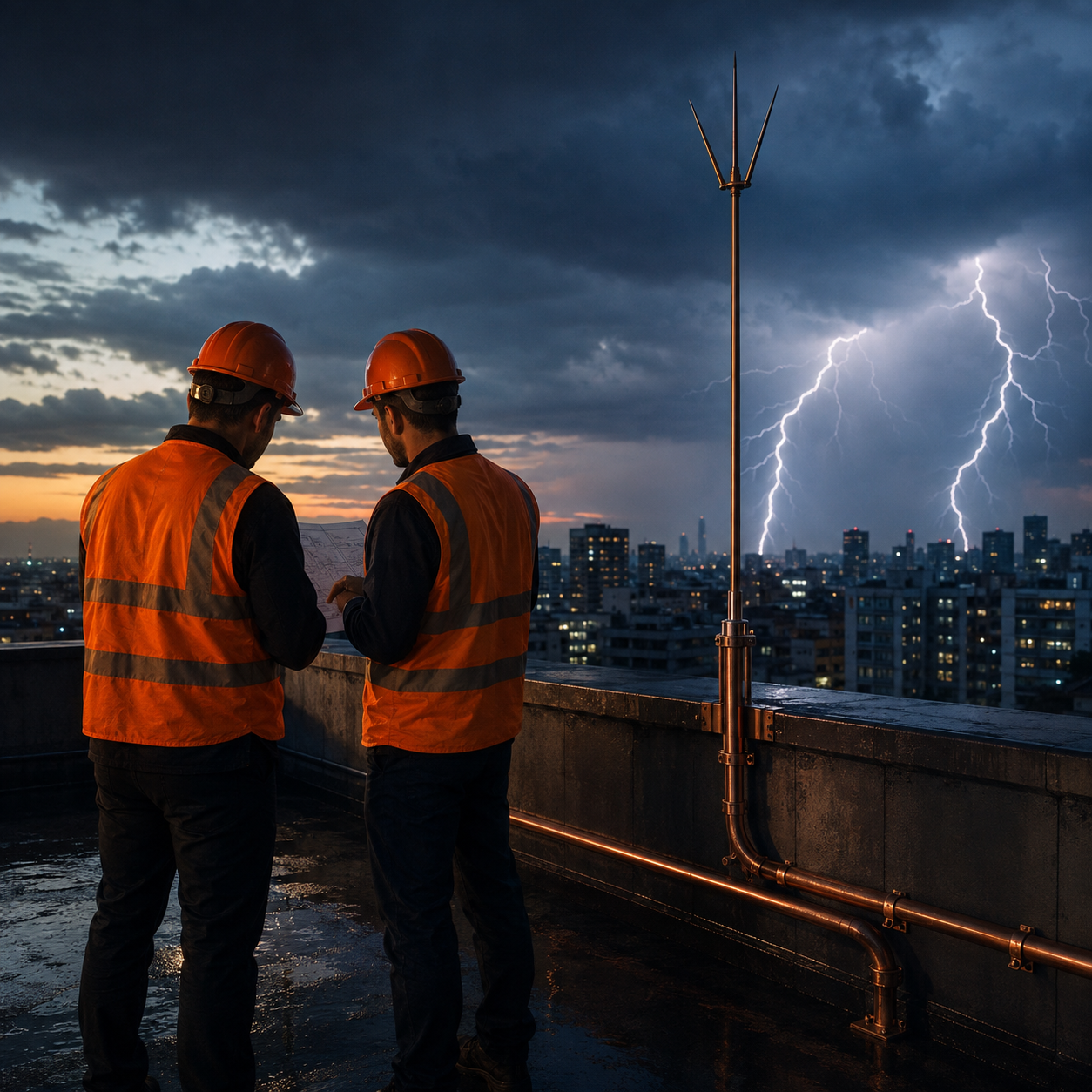
The contact-less sensor design is crucial for installation: the device is mounted directly onto the down-conductor without any modifications to the existing setup. The conductor is not cut, and no additional clamps or connections are required.
The device operates with a replaceable battery (CR17335 lithium) — with a battery life of up to two years. With IP 65 protection class and a UL 94V-Z polycarbonate housing, it is suitable for outdoor installation. The operating temperature is -20 °C … +60 °C.
The product complies with IEC 62561-6 standard and is RoHS, CE certified.
- Detects and records lightning strikes up to 100 kA (10/350 µs)
- Monitors the frequency, date, and time of discharges
- LCD screen — displays lightning count, hour, minute, and date
- Time/date setting and record viewing via buttons
- Recording capacity up to 999 events
- Threshold current: 1 kA (8/20 µs)
- Contact-less sensor — requires no modification to existing installation
- Direct mounting on the down-conductor
- Replaceable battery — CR17335 lithium, up to 2 years life
- Enables timely maintenance and preventive measures
- Reduces the risk of undetected lightning damage
- Easy installation design for outdoor mounting
- IP 65 protection class
- Housing: UL 94V-Z polycarbonate
- Operating temperature: -20 °C … +60 °C
- Standard: IEC 62561-6
- Certifications: RoHS, CE
Technical Data
| ProLEC Basic | |
|---|---|
| Order code | 130 523 |
| Threshold current Itc (8/20 µs) | 1 kA |
| Minimum withstand current Imcw (10/350 µs) | 100 kA |
| Max. number of recorded events | 999 |
| Power supply | CR17335 lithium battery — up to 2 years life |
| Mounting method | Directly on down-conductor |
| Operating temperature | -20 °C … +60 °C |
| Housing material | UL 94V-Z polycarbonate |
| Protection class | IP 65 |
| Dimensions (L×W×D) | 140 × 88.9 × 42.6 mm |
| Weight | 440 g |
| Standard | IEC 62561-6 |
| Certification | RoHS, CE |
ProLEC Basic is used to record strikes in structures with lightning protection systems:
- Buildings with lightning rods — Lightning strike recording on the down-conductor
- Lightning Protection System (LPS) inspection — Verification that the system has actually taken a load
- Industrial facilities — Factories, warehouses, and production buildings
- Solar power plants (SPP) — Ground and rooftop installations
- Wind power plants — Turbine and site infrastructure
- Telecom base stations and towers — High structural risk
- High-rise buildings and towers — Points with high probability of direct strikes
- Critical infrastructure facilities — Hospitals, data centers, substations
- Explosive environment facilities — Petrochemical, fuel, gas storage
- Periodic maintenance programs — Determining inspection time after a strike
- Insurance and damage assessment — Documentation with event date/time record
- Lightning risk analysis — Collecting site-specific actual strike data
- Retrofitting existing facilities — Contact-less sensor requires no installation intervention