Is a Lightning Protection System Mandatory?
Lightning protection is not automatically mandatory for every building; its necessity is determined through a risk assessment. TS EN / IEC 62305-2 evaluates the building’s location, dimensions, purpose of use, density of people and equipment inside, and the lightning density in the region to determine the level of acceptable risk. If the calculated risk exceeds the limit considered acceptable by the standard, appropriate protection measures are required.
In addition, lightning protection is required as part of the design and permitting processes for certain types of buildings. Facilities containing explosive or flammable materials, hospitals, schools, high-rise buildings, and crowded public buildings are among the primary examples.
In short, the question should not be “Is it mandatory?” but rather “Is the risk for my building at an acceptable level?” The way to determine this is through a risk assessment.
There Is a Lightning Rod on the Building; Do I Also Need Surge Protection?
Yes. These two are not alternatives to each other; they are complementary.
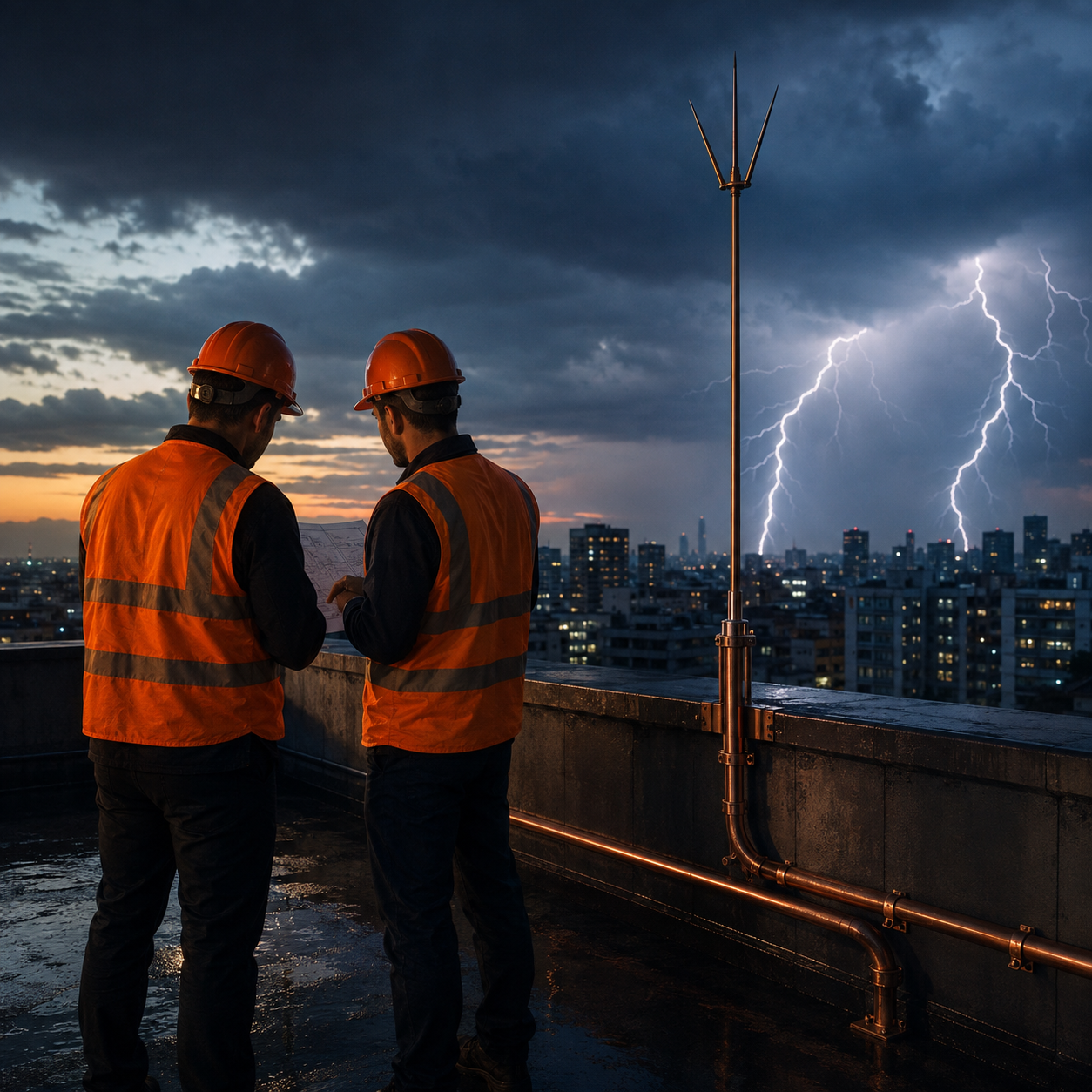
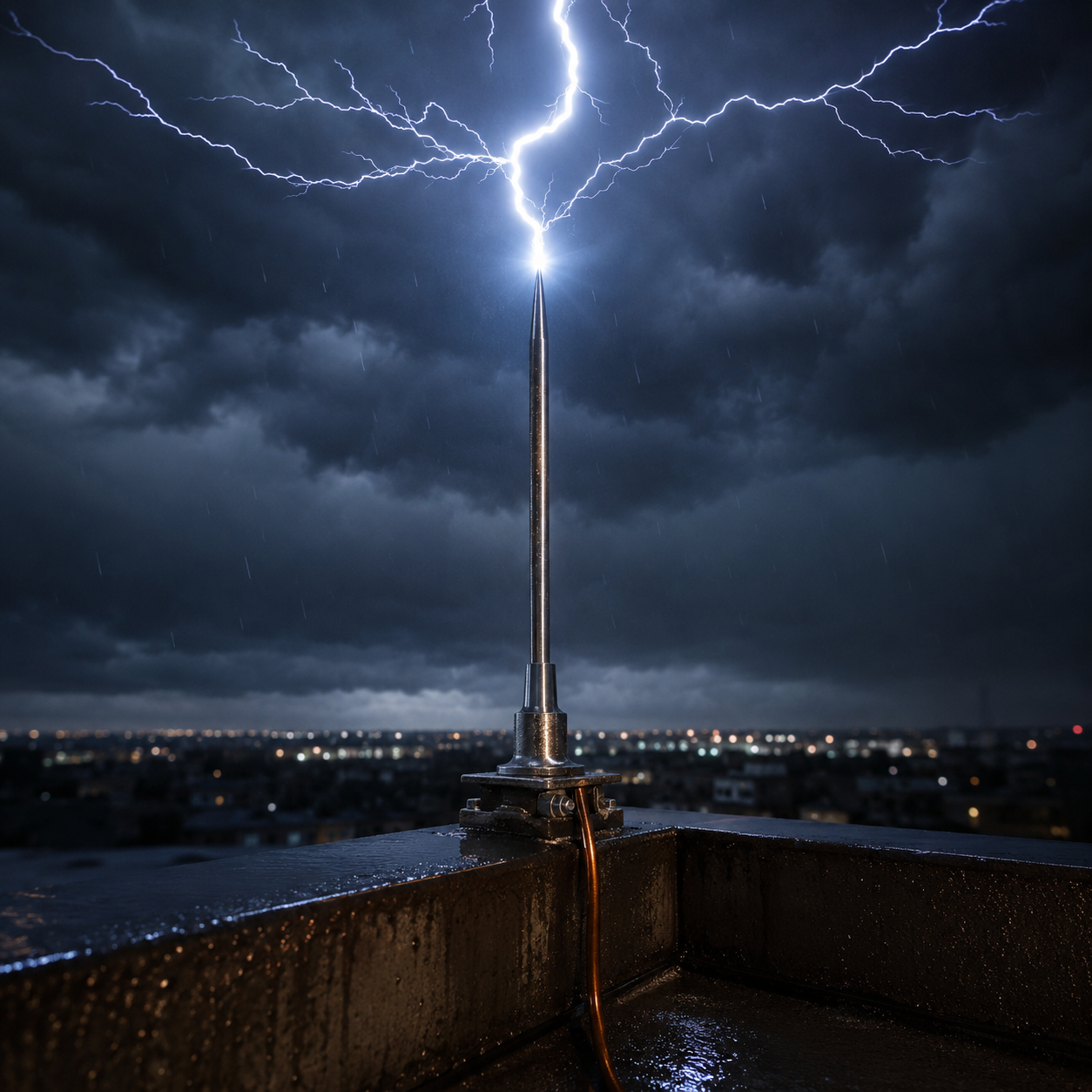
A lightning rod and air-termination system (external lightning protection) intercept the lightning strike instead of allowing it to strike the structure directly and conduct the current to earth through down conductors. In other words, it protects the physical integrity of the structure.
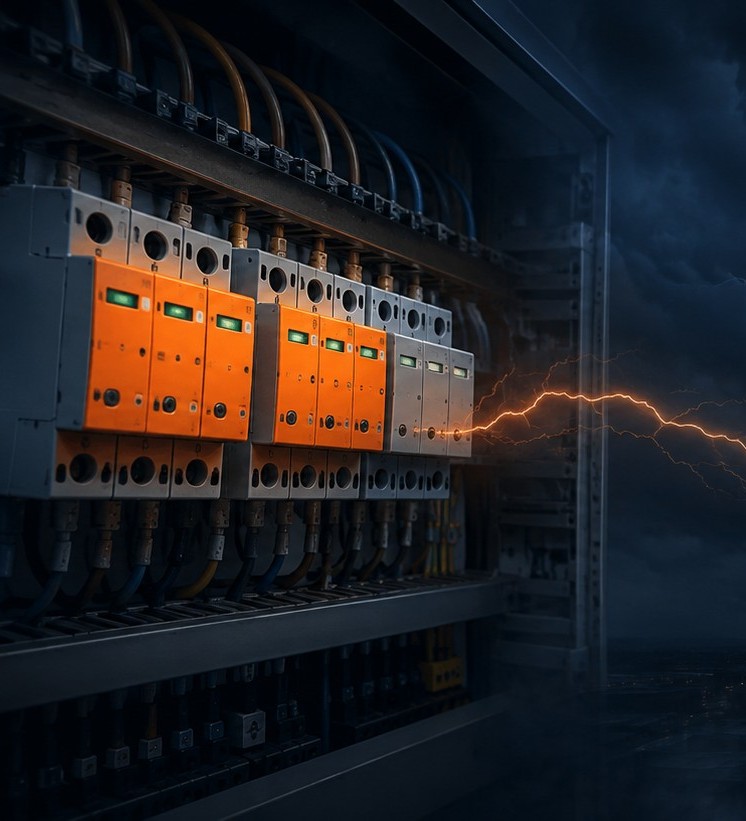
However, as this current flows to earth, it induces high voltages in the electrical and data installations inside the building. This is often what causes the actual damage to electronic equipment. A surge protective device (internal lightning protection) limits these induced voltages to levels that the equipment can withstand.
The most common situation we encounter in practice is this: there is a lightning rod on the roof, but no surge protective devices in the electrical panels. After a lightning event, the building remains standing, but PLCs, servers, elevator control boards, and the fire detection panel are damaged.
What Is a Lightning Risk Assessment and Why Is It Necessary?
A risk assessment determines the level of protection required for your building through calculation rather than estimation. It is carried out in accordance with TS EN / IEC 62305-2.
The assessment calculates the collection area based on the building’s length, width, and height. It also evaluates the lightning density in the region, the building’s position relative to its surroundings, roof and wall materials, the number of people inside and their occupancy duration, fire load, connected power and communication lines, and existing protection measures.
The result is the Lightning Protection Level (LPL I–IV) to be applied to the structure. This level directly determines the requirements for the air-termination system: for LPL I, a 20-meter rolling sphere and a 5 × 5 m mesh size are required, whereas for LPL IV these values are 60 meters and 20 × 20 m.
A design carried out without a risk assessment will either be unnecessarily costly or inadequate. Both are undesirable outcomes.
How Is the Protection Radius of a Lightning Rod Determined?
There are two different approaches in the industry regarding this subject, and it is useful to understand both.
TS EN / IEC 62305 determines the protected area using the rolling sphere method. An imaginary sphere with the specified radius is considered to roll over the structure; every point the sphere can touch is considered unprotected. The radius is 20, 30, 45, or 60 meters depending on the protection level. This method evaluates the geometry of the structure together with the positioning of the air-termination rods.
Early Streamer Emission (ESE) lightning protection systems are based on the NF C 17-102 standard and claim to provide a significantly larger protection radius compared with conventional air-termination rods. These products are widely used; however, IEC 62305 does not recognize this method as a standalone protection solution.
In practice, the correct approach is to verify the protected area using the rolling sphere method specified in IEC 62305 and base product selection on this calculation. We can evaluate together which solution is suitable for your structure.
What Should the Grounding Resistance Be in Ohms?
This is one of the most frequently asked but most commonly misunderstood questions.
A commonly accepted practice for lightning protection systems is to maintain grounding resistance below 10 ohms. However, this is not a single target value applicable to every facility; different limits may apply depending on the type of facility, the purpose of the grounding system, and the applicable regulations. Protective grounding, lightning protection grounding, and functional grounding in electrical installations have different requirements.
There are two more important points:
Resistance alone is not a sufficient criterion. Lightning current is a high-frequency phenomenon; not only the electrode’s resistance but also its impedance and geometry are important. A distributed electrode network often provides better results than a single long earth rod.
Ground resistance is not constant. Soil resistivity changes with moisture; the value measured in dry soil during summer can differ significantly from the value measured after rainfall. Therefore, testing should not be a one-time measurement but should be carried out periodically.
How Long Does a Surge Protective Device Last and When Should It Be Replaced?
A surge protective device does not have a fixed service life based solely on time. Its lifespan is determined by the number and severity of surges it experiences. A device that is not exposed to significant surges may operate for many years, while a device subjected to repeated severe surges may reach the end of its service life in a short time.
Classic varistor-based surge protective devices leave a trace after each surge. When the device reaches the end of its service life, its status indicator changes from green to red. The main risk is that this condition may go unnoticed — a surge protective device with a red indicator still appears to be installed, while the facility continues operating without protection.
There are two ways to eliminate this blind spot: regularly checking the indicators during periodic inspections, or using remotely monitored communication-enabled solutions to transmit the protection status to a central system. The latter is almost essential at sites where personnel are not continuously present.
Another option is to use technologies that do not require a separate fuse or thermal disconnector and can continue providing protection after successive surges. They are preferred in facilities where interruptions are not acceptable.
How Often Should a Lightning Protection System Be Inspected?
Lightning protection is not a system that can simply be installed and forgotten. There are three known reasons why its performance may deteriorate over time:
- Ground resistance changes — soil moisture varies seasonally.
- Connections are subject to corrosion — particularly in coastal and chemical environments, where corrosion progresses more rapidly.
- Surge protective devices reach the end of their service life — if this goes unnoticed, protection is silently lost.
The inspection interval is determined according to the protection level, type of facility, and applicable regulations. In Türkiye, annual measurement and inspection is a common practice; the frequency may be increased for critical facilities such as explosive atmospheres.
During an inspection, grounding resistance is measured, continuity is checked, the air-termination and down-conductor systems are visually inspected, surge protective device indicators are checked, and the results are documented. The report is important — it serves as a reference document during audits and post-damage assessments.
What Determines the Cost?
The cost of a lightning protection system is not determined by a single item but by several factors combined:
Protection Level (LPL). In a structure classified as LPL I based on the risk assessment, the air-termination system is designed with much stricter requirements; material and labor costs are significantly higher compared with LPL IV.
Building geometry. Roof area, building height, the number of down conductors, and the density of rooftop equipment have a direct impact on the system requirements.
Ground conditions. In areas with high soil resistivity, additional electrodes and alternative grounding methods may be required to achieve the target resistance.
Internal lightning protection scope. There is a significant difference between installing a surge protective device only at the main distribution board and providing coordinated protection for the main board, sub-distribution boards, machine panels, and signal lines.
Existing condition. In a new project, the system is designed from the ground up; in an existing structure, measurements and inspections are first carried out to identify deficiencies.
For this reason, an accurate quotation can only be provided after a site inspection and risk assessment. Figures quoted over the phone often either leave out part of the required scope or include more than necessary.
Can Lightning Strike the Same Place Twice?
It does — and this is not the exception, but the rule.
The saying “lightning never strikes the same place twice” is a common misconception. In reality, lightning seeks the easiest path between the cloud and the ground, which is generally the highest and most conductive point in the surrounding area. If that point is suitable once, it can be suitable again.
For this reason, tall structures, chimneys, antenna masts, wind turbines, and facilities located at elevated points can be struck by lightning more than once a year. Lightning protection systems are designed with this assumption in mind: to withstand not just a single strike, but repeated strikes.
There is a practical consequence to this. Instead of assuming that a facility that has already been struck by lightning “will not be struck again,” the condition of the protection system should be checked — because that structure may be more likely to be targeted again than surrounding structures.
Can a lightning protection system be installed on an existing building?
Yes, it can. A significant portion of our applications are already carried out on existing buildings.
The difference from a new project is that, in a new building, the system is designed together with the architecture, down conductors can be concealed within the reinforced concrete, and foundation grounding can be installed during construction. In an existing building, the solution is adapted to the building as it currently stands.
The process works as follows:
- Site inspection – the roof structure, existing installation, electrical panel architecture, and any existing protection components are inspected.
- Measurement – grounding resistance and continuity are measured; most buildings already have an existing grounding system that can be evaluated and utilized.
- Risk assessment – the required protection level is determined.
- Adapted design – routing that preserves the visual integrity of the façade and surge protection solutions compatible with the existing panels are selected.
The most common situation in existing buildings is having an external lightning protection system without any internal lightning protection. In such cases, completing the missing protection on the electrical panel side is often the fastest and most effective step.
Why is a separate DC surge protective device required in a solar power plant?
Because the physics on the DC side is different.
In an AC network, the current crosses zero every half cycle, so an arc naturally extinguishes. There is no such zero crossing in DC – the arc does not extinguish on its own. An incorrectly selected DC surge protective device, or one with inadequate disconnection behavior, can become a continuous source of arcing and overheating instead of providing protection. This is one of the known causes of fires in solar PV installations.
For this reason, specific standards apply to photovoltaic systems, including EN 50539-11 and IEC/EN 61643-31. A general-purpose DC surge protective device is not covered by these standards and should not be used in PV applications.
Two questions are decisive when selecting the device:
- Is there an external lightning protection system on site? Type 1 if present; Type 2 if not.
- What is the system voltage? Different products are used for 1100 V DC and 1500 V DC systems.
The inverter’s DC input and AC output should both be protected; protecting only one side does not provide protection against surges entering from the other side.
Which technical parameters should I consider when selecting a surge protective device?
The following parameters are decisive, respectively:
Type (Class). Type 1 carries part of the direct lightning current and is tested with a 10/350 µs waveform. Type 2 limits induced overvoltages and is tested with an 8/20 µs waveform. Type 3 provides final equipment protection and is not used alone. If the building has an external lightning protection system, Type 1 is required at the main distribution board — Type 2 does not replace it.
Uc — maximum continuous operating voltage. The voltage that the surge protective device can withstand continuously. It must be selected above the system voltage; otherwise, it may fail during normal operation.
Iimp / In / Imax — current capacity. For Type 1, the Iimp (10/350 µs) value is considered; for Type 2, the In and Imax (8/20 µs) values are considered. A higher value does not always mean “better”; it should be evaluated together with the required protection level.
Up — voltage protection level. The residual voltage let through by the surge protective device to the equipment. This is the most critical value. The impulse withstand voltage of the equipment to be protected must be higher than Up; otherwise, the surge protective device may operate correctly while the equipment can still be damaged.
SCCR — short-circuit withstand rating. It must be higher than the prospective short-circuit current at the installation point.
Configuration. It is determined according to the power system earthing arrangement: 3+0 for TN-C, 4+0 or 3+1 for TN-S, and 3+1 for TT (with a spark gap between neutral and protective conductor).
There is also a practical consideration: module width (TE). If there is not enough space in the panel, even the right product cannot be installed.
Is a fuse required upstream of the surge protective device?
In most cases, yes, but careful selection is required.
When the surge protective device reaches the end of its service life or fails, it must be safely disconnected from the circuit. This function is jointly performed by the device’s built-in thermal disconnector and the backup protective device upstream, such as a fuse or circuit breaker.
The balance here is:
- If the fuse is undersized, it may trip unnecessarily during a lightning surge, leaving the installation unprotected.
- If the fuse is oversized, it may fail to disconnect the surge protective device in the event of a fault, creating a fire risk.
The correct rating is the maximum backup fuse value specified in the manufacturer’s datasheet. If the installation’s main fuse is smaller than this value, no separate fuse is required; if it is larger, a separate fuse is installed on the surge protective device branch.
To eliminate this complexity, models with integrated fuses, such as ProTec T2F, are available; they eliminate the need for a separate fuse space in the panel and remove the risk of incorrect fuse selection.
In critical facilities, technologies without fuses or thermal disconnectors may also be preferred, as protection would otherwise be completely lost when the fuse operates.
What is equipotential bonding, and why is it so important?
It is one of the most overlooked, yet perhaps one of the most critical, parts of lightning protection.
As lightning current flows to ground, it creates a potential difference along its path. If two metal masses within the structure experience this difference — for example, a water pipe and a cable tray — an electrical flashover (side flash) can occur between them. This creates both fire and personnel safety risks.
Equipotential bonding eliminates these differences by connecting all conductive masses within the structure to a common potential. This includes structural steel, water and natural gas pipes, cable trays, ventilation ducts, elevator rails, the grounding system, and all incoming services.
In one sentence: a surge protective device is only as effective as the equipotential bonding network behind it. In a facility without proper equipotential bonding, even the most expensive surge protective device cannot perform its function fully — because the ground reference is not the same at every point in the installation.
Lightning struck — what should I do now?
Take the following steps in order:
1. Do not energize equipment that appears to be damaged. Equipment that appears to be functioning may have suffered internal damage; re-energizing it may worsen the damage.
2. Check the surge protective device indicators. Modules that have changed from green to red have operated and reached the end of their service life. The installation remains unprotected until they are replaced.
3. Have the grounding and continuity measurements performed. High current can cause damage at connection points that may not be visible. The air-termination system and down conductors should also be visually inspected.
4. Document everything. A list of damaged equipment, photographs, measurement reports, and the time of the incident, if available. These are required for the insurance claim process.
5. Investigate the root cause. The same incident may happen again. Repairs made without determining whether the protection was adequate, where the surge entered, and which protection stage was missing may lead to the same result during the next storm.
If you need support with these steps, we are here to help with our post-damage inspection and measurement services.
Does my insurance policy cover lightning damage?
The definitive answer is stated in your insurance policy; coverage and exclusions vary between insurers and insurance products. As we are not insurance advisors, we cannot provide a binding interpretation of your specific policy — but we can explain the technical aspects that are relevant to the process.
Lightning-related damage is covered by many insurance policies. However, two points are particularly important in practice:
Being able to demonstrate that the damage was caused by lightning. Measurement reports, the condition of the surge protective device indicators, meteorological data from the date of the incident, and the nature of the damage support this determination.
The system must have been installed in accordance with the applicable standards and regularly inspected. Periodic measurement and inspection reports document that the installation has been properly maintained. The absence of these records may create a gap that could be interpreted unfavorably during the process.
My practical advice is: keep your inspection reports up to date and retain them. These documents are useful not only for inspections but also in the event of damage. Clarify the scope of your insurance policy with your insurance company or agent.