ProSLS
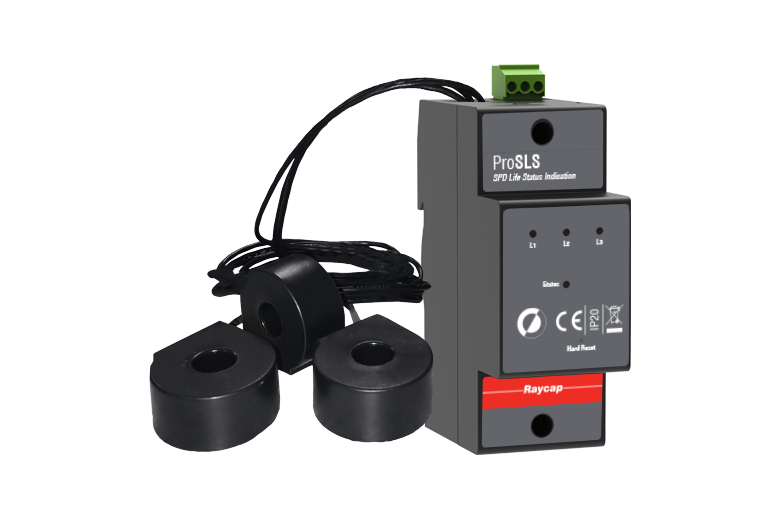
Raycap ProSLS is an end-of-life indicator that continuously monitors the leakage current of a Surge Protective Device (SPD). Leakage current is the most accurate indicator of an SPD's end-of-life status. Using the measured current, ProSLS predicts advanced SPD degradation and communicates this information to the user. It automatically adapts to all SPD sizes and models, operates with a replaceable battery, and offers a remote contact output.
Surge Protective Devices (SPDs) do not fail instantly — they degrade gradually. Each surge leaves a small change in the varistor's structure. This degradation begins long before the green/red flag indicator on the device's front panel is activated. Traditional indicators only warn after a failure has occurred; at that point, protection is already lost.
ProSLS uses a different approach: leakage current measurement. As a varistor degrades, its continuous leakage current increases. This is the most accurate indicator of an SPD's end-of-life status — and it is a measurable quantity before failure.
The device continuously monitors leakage current. It can measure currents as low as 100 µA. If the leakage current remains at or above 5 mA for 1 hour , the ProSLS issues an SPD degradation alarm. This allows the SPD to be replaced as part of planned maintenance before it fails — ensuring uninterrupted protection.
Automatically adapts to all SPD sizes and models — no separate adjustment is required for SPDs from different manufacturers or types.
The device 1 A / 45 V AC / 30 V DC rated remote contact output — information can be directly transferred to a PLC or SCADA system. The front panel features a status indicator and a hard reset button; separate L1, L2, L3 indicators are provided for three phases.
The leakage current sensor is clamped around the conductor; cable diameters up to 12 mm are supported. A 1 m sensor cable provides installation flexibility.
Powered by a replaceable 3.6 V (ER AA) battery — battery life is up to two years. It is 35 mm DIN rail mountable and 2 TE wide. Operating temperature is -30 °C … +70 °C.
The product complies with IEC/EN 61326-1 standard; it is RoHS and CE certified.
ProSLS
Brief Description (summary / meta)
Raycap ProSLS is an end-of-life indicator that continuously monitors the leakage current of a Surge Protective Device (SPD). Leakage current is the most accurate indicator of an SPD's end-of-life status. Using the measured current, ProSLS predicts advanced SPD degradation and communicates this information to the user. It automatically adapts to all SPD sizes and models, operates with a replaceable battery, and offers a remote contact output.
Overview
Surge Protective Devices (SPDs) do not fail instantly — they degrade gradually. Each surge leaves a small change in the varistor's structure. This degradation begins long before the green/red flag indicator on the device's front panel is activated. Traditional indicators only warn after a failure has occurred; at that point, protection is already lost.
ProSLS uses a different approach: leakage current measurement. As a varistor degrades, its continuous leakage current increases. This is the most accurate indicator of an SPD's end-of-life status — and it is a measurable quantity before failure.
The device continuously monitors leakage current. It can measure currents as low as 100 µA. If the leakage current remains at or above 5 mA for 1 hour, the ProSLS issues an SPD degradation alarm. This allows the SPD to be replaced as part of planned maintenance before it fails — ensuring uninterrupted protection.
Automatically adapts to all SPD sizes and models — no separate adjustment is required for SPDs from different manufacturers or types.
The device has a 1 A / 45 V AC / 30 V DC rated remote contact output — information can be directly transferred to a PLC or SCADA system. The front panel features a status indicator and a hard reset button; separate L1, L2, L3 indicators are provided for three phases.
The leakage current sensor is clamped around the conductor; cable diameters up to 12 mm are supported. A 1 m sensor cable provides installation flexibility.
Powered by a replaceable 3.6 V (ER AA) battery — battery life is up to two years. It is 35 mm DIN rail mountable and 2 TE wide. Operating temperature is -30 °C … +70 °C.
The product complies with IEC/EN 61326-1 standard; it is RoHS and CE certified.
Features
- Continuously monitors the leakage current of an SPD
- Predicts advanced degradation using measured current and notifies the user
- Automatic adaptation to all SPD sizes and models
- Lowest measurable current: 100 µA
- SPD degradation alarm: ≥ 5 mA, for 1 hour
- Remote contact output: 1 A / 45 V AC / 30 V DC
- Separate indicators for three phases (L1, L2, L3)
- Hard reset button
- Replaceable battery — 3.6 V (ER AA), up to 2 years life
- Max. cable diameter through sensor: 12 mm
- Sensor cable: 1 m
- 35 mm DIN rail mounting (EN 60715)
- Compact size: DIN 43880 2 TE
- Protection class: IP 20
- Housing: UL 94 V-0 flame retardant thermoplastic
- Operating temperature: -30 °C … +70 °C
- Standard: IEC/EN 61326-1
- Certifications: RoHS, CE
Technical data
| ProSLS | |
|---|---|
| Order code | 130 551 |
| Lowest measurable current (SPD leakage) | 100 µA |
| SPD degradation alarm | ≥ 5 mA, for 1 hour |
| Power supply | Replaceable 3.6 V (ER AA) battery |
| Battery life | Up to 2 years |
| Remote contacts | 1 A — 45 V AC / 30 V DC |
| Mounting method | 35 mm DIN rail (EN 60715) |
| Max. cable diameter through current sensor | 12 mm |
| Sensor cable | 1 m |
| Operating temperature | -30 °C … +70 °C |
| Housing material | Thermoplastic, UL 94 V-0 |
| Protection class | IP 20 |
| Dimensions | DIN 43880 2 TE |
| Packaging dimensions | 110 × 115 × 75 mm |
| Weight | 399 g |
| Standard | IEC/EN 61326-1 |
| Certification | RoHS, CE |
ProSLS is used in installations where SPDs must be replaced before failure:
- LV distribution panels — SPD end-of-life monitoring
- Predictive maintenance programs — Planned replacement before failure
- Critical infrastructure facilities — Hospitals, data centers, substations
- Installations requiring uninterrupted protection — Where loss of protection is unacceptable
- Industrial facilities — Factory and production panels
- Solar power plants (SPPs) — Monitoring SPD degradation
- Wind Power Plants — High Strike Activity Sites
- Telecom base stations — Remote and hard-to-reach locations
- High lightning activity regions — Installations expecting rapid degradation
- Remotely monitored facilities — SCADA/PLC integration with RC contact
- Three-phase systems — With separate L1, L2, L3 indicators
- Facilities with different SPD brands/models — With automatic adaptation feature
- Retrofitting existing panels — Sensor clamped around conductor