ProSEC II+
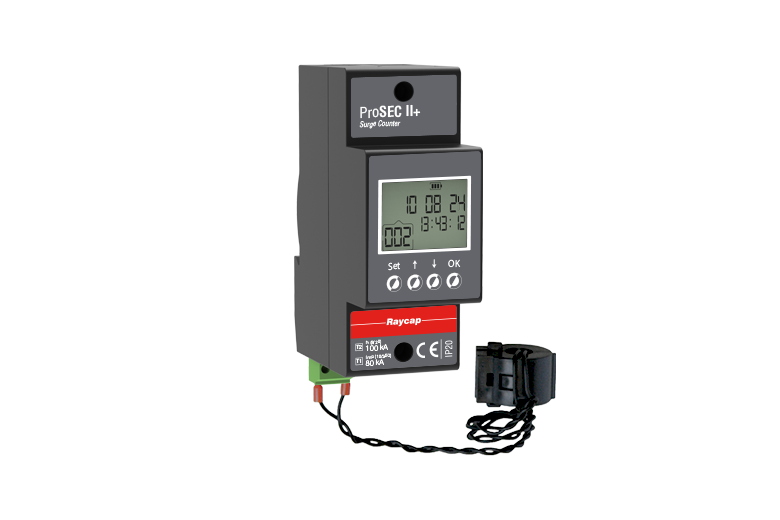
Raycap ProSEC II+ is a surge counter with additional functions. In addition to counting surges, it records the hour and date of each surge. This time and date recording function makes it possible to determine the exact time of each surge and correlate it with equipment and supply issues within the facility. Features an LCD screen, DIN rail mounting, snap-on current sensor, and IEC 62561-6 compliance.
When devices in a facility malfunction, it is often impossible to determine if the cause is a grid-induced surge or another problem. A surge arrester may have operated, but without a record, the cause-and-effect relationship cannot be established.
ProSEC II+ eliminates this uncertainty. The device not only counts the number of surges but also records the hour, minute, and date of each surge. Thus, when equipment failure occurs, the record history can be checked to definitively determine if a surge occurred at that moment — and the failure can be linked to its true cause.
The LCD screen directly displays the surge count and event time. Hour/date settings can be adjusted and log history viewed using the buttons on the device. It records up to 999 events.
The measurement range is wide: 100 A to 100 kA (8/20 µs) and 100 A to 80 kA (10/350 µs). This means it detects both small switching surges and direct lightning currents. It is in the Type I and Type II EN/IEC category.
The snap-on impulse current sensor simplifies installation: the sensor is placed around the conductor without cutting it. Cable diameters up to 14 mm are supported; a 0.5 m sensor cable provides distance between the device and the sensor.
The device operates with a replaceable CR17335 lithium battery — battery life is up to two years. It is 35 mm DIN rail mounted, only 2 TE wide. Operating temperature is -20 °C … +70 °C.
The product complies with IEC 62561-6 standard; RoHS and CE certified.
- Counts surge events
- Records the hour and date of each counted surge
- LCD screen — displays surge count, hour, minute, and date
- Buttons for hour/date setting and log viewing
- Recording capacity up to 999 events
- Correlation of surges with equipment and supply issues
- Easy installation — snap-on impulse current sensor
- Wide measurement range: 100 A – 100 kA (8/20 µs) / 100 A – 80 kA (10/350 µs)
- Replaceable battery — CR17335 lithium, up to 2 years life
- Max. cable diameter through sensor: 14 mm
- Sensor cable: 0.5 m
- 35 mm DIN rail mounting (EN 60715)
- Compact size: DIN 43880 2 TE
- Protection class: IP 20
- Housing: UL 94 V-0 flame retardant thermoplastic
- Operating temperature: -20 °C … +70 °C
- Standard: IEC 62561-6
- EN/IEC category: Type I, Type II
- Certifications: RoHS, CE
Technical data
| ProSEC II+ | |
|---|---|
| Order code | 130 100 |
| Minimum discharge current Imin (8/20 µs) | 100 A |
| Nominal discharge current In (8/20 µs) | 100 kA |
| Minimum impulse discharge current Iimp min (10/350 µs) | 100 A |
| Impulse discharge current Iimp (10/350 µs) | 80 kA |
| Power supply | Replaceable CR17335 lithium battery |
| Battery life | Up to 2 years |
| Max. number of recorded events | 999 |
| Mounting method | 35 mm DIN rail (EN 60715) |
| Max. cable diameter through current sensor | 14 mm |
| Sensor cable | 0.5 m |
| Operating temperature | -20 °C … +70 °C |
| Protection class | IP 20 |
| Housing material | Thermoplastic, UL 94 V-0 |
| Dimensions | DIN 43880 2 TE |
| Packaging dimensions | 110 × 42 × 83 mm |
| Weight | 150 g |
| Standard | IEC 62561-6 |
| EN/IEC category | Type I, Type II |
| Certifications | RoHS, CE |
ProSEC II+ is used in facilities where surge events need to be counted and time-stamped recorded:
- LV distribution panels — Counting surges passing through surge arresters
- Main and sub-distribution panels — Monitoring surge activity
- Fault root cause analysis — Correlating equipment failure with surges
- Critical infrastructure facilities — Hospitals, data centers, substations
- Industrial facilities — Determining the cause of production downtime
- Solar power plants (SPP) — DC and AC side surge activity
- Wind power plants — Turbine and site infrastructure
- Telecom base stations — Monitoring surge frequency
- Periodic maintenance programs — Tracking surge arrester degradation
- Insurance and damage assessment — Documentation with event date/time records
- Lightning risk analysis — Collecting site-based actual surge data
- Protection system performance evaluation — Verification of coordination sizing
- Retrofitting existing panels — Snap-on sensor, installation without cutting conductors