ProTec T1S
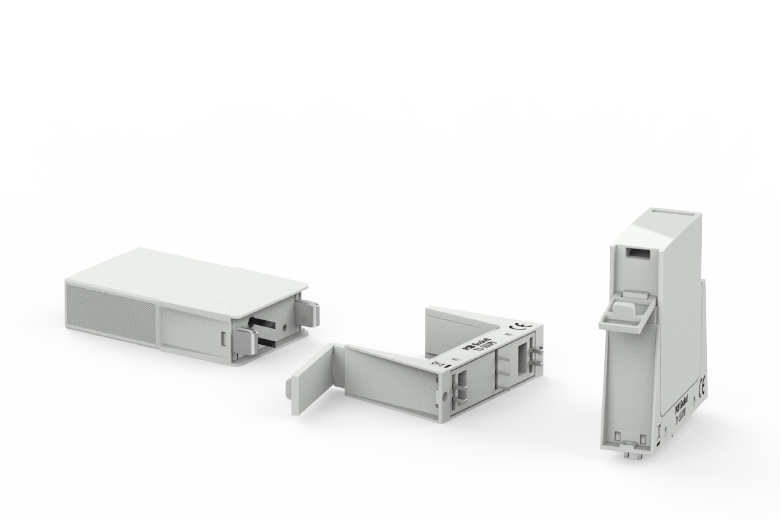
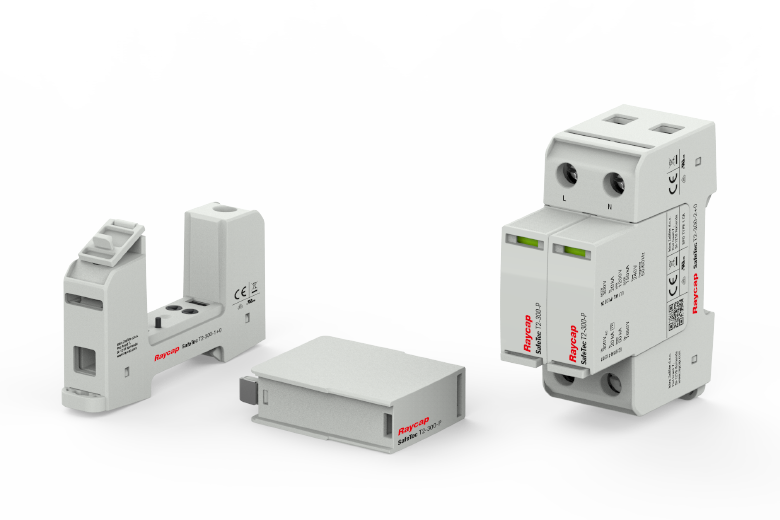
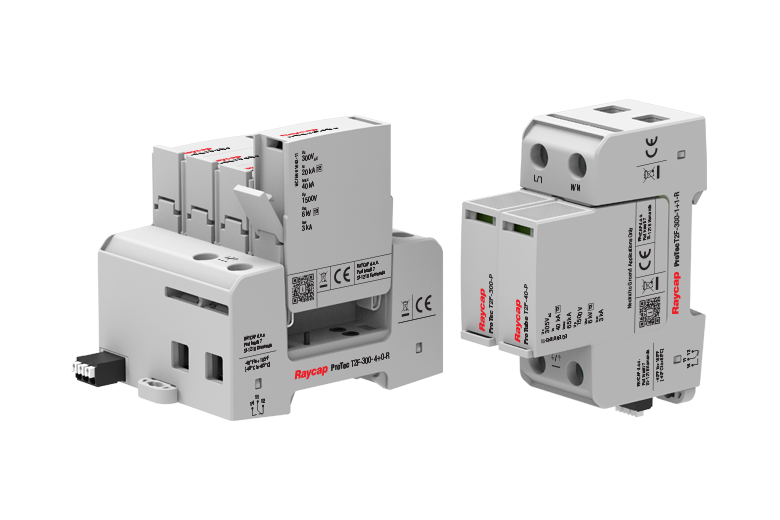
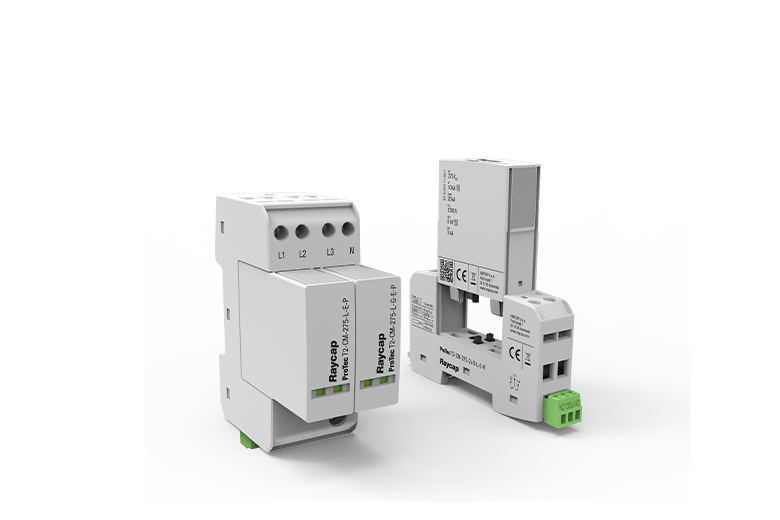
The Raycap ProTec T1S is a DIN rail mounted Class I+II / Type 1+2 Surge Protective Device (SPD) designed in a compact, pluggable housing. Thanks to Raycap's proprietary Phase-GDT technology, it offers a residual voltage value close to varistor-based devices in a housing half the size of its competitors and does not generate leakage current.
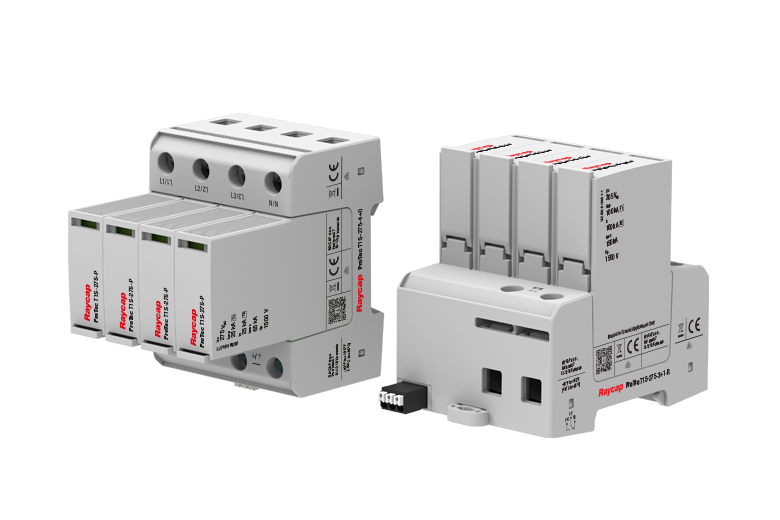
ProTec T1S are DIN rail mounted Class I+II / Type 1+2 surge protective devices designed in a compact, pluggable housing. They can be used in cascaded protection schemes with Type 2 or Type 3 SPDs.
The product is based on Raycap's proprietary Phase-GDT (PGDT) technology. This technology optimizes both voltage-switching and voltage-limiting SPD approaches, resulting in an ideal Class I device in a DIN rail format. This preserves the compact housing advantage of voltage-switching technology while eliminating its known disadvantages — high residual voltage and poor follow current performance.
ProTec T1S utilizes multi-cell and encapsulated GDT technology. The result is a residual voltage value close to that of a varistor (MOV) based SPD; moreover, this is achieved in a housing half the size of its market equivalents and without restrictions on where it can be mounted in the network. The multi-cell design also significantly reduces follow current.
- Class I+II / Type 1+2 SPD
- Raycap proprietary Phase-GDT (PGDT) technology
- Multi-cell, encapsulated GDT structure
- Discharge capacity: From 100 kA (10/350 µs) in 4TE housing
- Leakage current free topology
- Low residual voltage: Up = 1.5 kV
- Suitable for networks with high prospective short-circuit current
- Suitable for repetitive operation in networks with Ip values up to 50 kA at 50/60 Hz
- Reduced follow current due to multi-cell design
- Can be used with Type 2 or Type 3 SPDs
- Meets Class I test requirements according to IEC 61643-11
- VDE certified
- Compact, pluggable housing
- DIN rail mounting
- Module configurations: 1+0, 2+0, 3+0, 4+0
ProTec T1S stands out in installations where panel space is limited and leakage current is undesirable:
- Compact main distribution boards — Space saving due to half-size advantage
- Installations where leakage current is undesirable — Systems where RCD sensitivity causes issues
- Networks with high short-circuit currents — Repetitive operation up to Ip 50 kA
- Industrial facilities — Main supply and distribution panels
- Commercial buildings — Building entrance panel protection
- Renovation projects — Situations where a standard Type 1 does not fit into an existing panel due to space constraints
- Cascaded protection schemes — With Type 2 and Type 3 devices