Monitoring Units – Narrow Line (RayDat NMU Series)
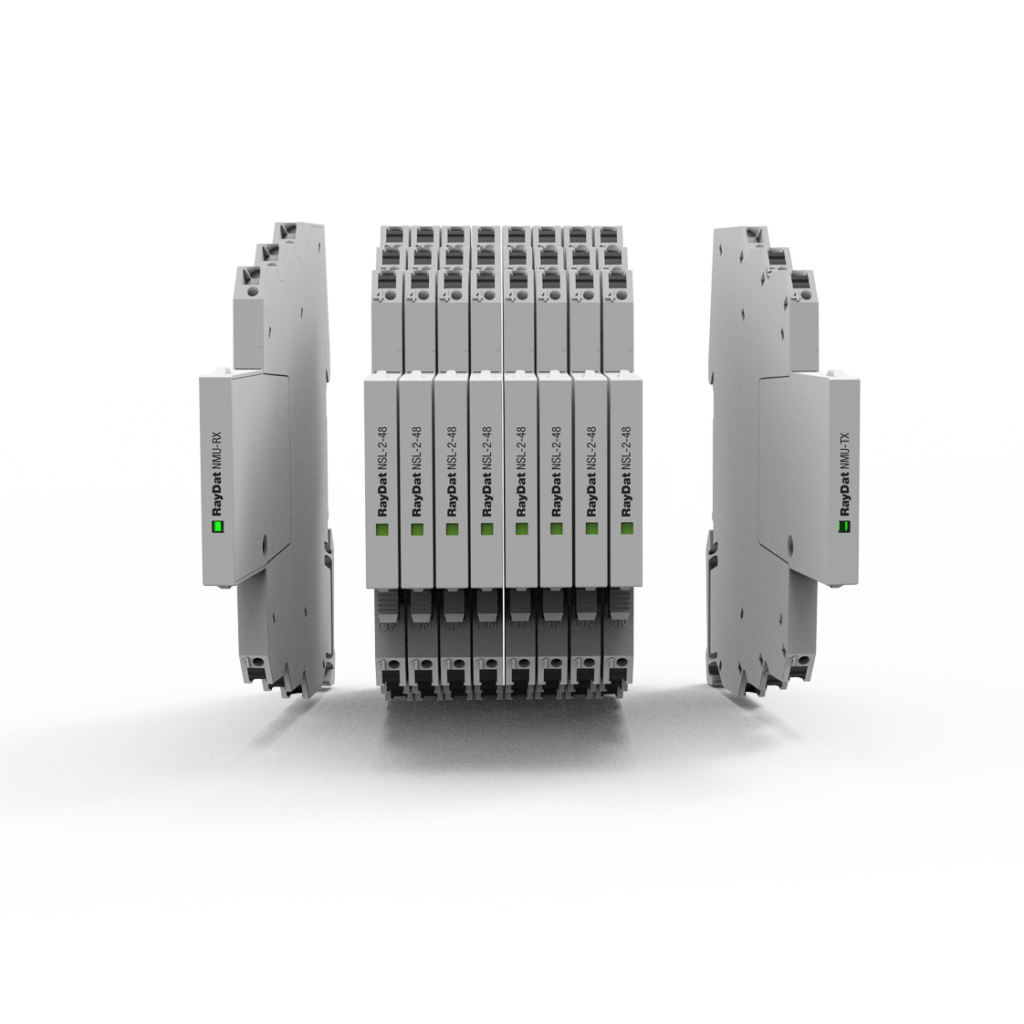
The Raycap RayDat NMU series is a transmitter (NMU-TX) and receiver (NMU-RX) unit pair that continuously monitors the status of the Narrow Line SPD array. When placed at both ends of the array, it controls up to 50 surge arresters in sequence. The transmitter unit emits a directional light beam that passes through the products; the receiver unit monitors this beam to detect faults. Each SPD has its own LED indicator. It offers 6.2 mm width, 6–36 V DC supply, and remote contact output.
In a panel with hundreds of signal points, it is not practical to visually check the status of each surge arrester individually. The classic solution is to run a separate remote contact for each module — which means a significant wiring load.
The RayDat NMU series offers a different approach to this problem: optical chain monitoring. The system consists of two units:
- NMU-TX (Transmitter Unit) — Placed at one end of the array. Emits a directional light beam.
- NMU-RX (Receiver Unit) — Placed at the other end of the array. Receives the beam and evaluates the status.
The light beam passes through the individual products in between to reach the receiver. If any surge arrester fails, the chain is broken, and the receiver unit detects the fault. A single NMU pair can monitor up to 50 SPDs — meaning one monitoring line is sufficient for 50 modules.
The specific faulty module is immediately visible via each SPD's own LED indicator — no panel scanning is required to locate the fault.
The NMU-RX features a remote contact (RC) output (max. 50 V DC / 500 mA DC) — fault information can be directly transmitted to a PLC or SCADA system. The unit has a green LED (normal) / red LED (fault) indicator. The NMU-TX shows operating status with a green LED.
The units operate on 6–36 V DC systems (rated 24 V DC), drawing 60 mA current. Like other products in the Narrow Line family, they are only 6.2 mm wide and equipped with quick-connect terminals.
The products comply with IEC/EN 61010-1, IEC/EN 61326-1, and UL 497B 4th Edition standards.
- Narrow form factor — only 6.2 mm wide
- Monitoring up to 50 SPDs with one NMU pair
- Optical monitoring principle — transmitter emits directional light beam, receiver evaluates
- SPD faults monitored by the receiver unit
- Each SPD has its own LED indicator — rapid fault detection
- Use in 6 – 36 V DC systems
- Quick-connect terminals
- Remote contact (RC) output — PLC/SCADA integration (NMU-RX)
- Status indication: green LED (normal) / red LED (fault) + RC contact
- Internal LED indicators
- Compatible with all Narrow Line product variants
- 35 mm DIN rail mounting (IEC/EN 60715)
- Protection class: IP 20 (embedded)
- Housing: gray thermoplastic, V-0 flame resistance
- Operating temperature: -40 °C … +80 °C
- Standards: IEC/EN 61010-1, IEC/EN 61326-1, UL 497B 4th Edition
Electrical values
| NMU-TX (Transmitter) | NMU-RX (Receiver) | |
|---|---|---|
| Max. number of SPDs monitored | Up to 50 | Up to 50 |
| Operating voltage Umin – Umax | 6 – 36 V DC | 6 – 36 V DC |
| Rated voltage UN | 24 V DC | 24 V DC |
| Operating current I | 60 mA DC | 60 mA DC |
| Output (remote contact) | — | max. 50 V DC / 500 mA DC |
| Status indication | Green LED | Green LED / Red LED / RC contact |
Mechanical
- Dimensions: 6.2 mm width (DIN 43880)
- Weight: NMU-TX 50 g · NMU-RX 52 g · NMU Set 102 g · Spare module 14 g
- Conductor cross-section (max.): 4 mm² (solid) / 2.5 mm² (flexible)
- Mounting: 35 mm DIN rail (IEC/EN 60715)
- Packaging: 113 × 111 × 11 mm (set: 18.5 mm)
The RayDat NMU series is used for monitoring Narrow Line SPD arrays:
- Narrow Line SPD arrays — Collective monitoring of analog, digital, and DC modules
- Marshalling and instrumentation panels — Panels with hundreds of signal points
- Automation and control panels — PLC field connection points
- Remotely monitored facilities — SCADA/PLC integration with RC contact
- Hard-to-access sites — Centralized monitoring instead of on-site checks
- Critical infrastructure facilities — Continuous verification of protection status
- Periodic maintenance programs — Elimination of manual inspection burden
- Large-scale installations — Monitoring up to 50 modules with a single pair
- Facilities requiring rapid fault detection — Location identification via LED per module
- 24 V DC control systems — Powered by existing control voltage
- Harsh industrial environments — -40 °C … +80 °C operating range