Phase–Phase Voltage and SPD Selection | Square Root of 3 (√3) Rule
Selections made without considering phase–phase and phase–ground voltage values, the square root of 3 (√3) rule, and the Uc continuous operating voltage level;
may cause the SPD to be exposed to long-term high voltage, leading to burnout and the situation of “there is protection, but actually there isn’t.”
YILKOMER does not treat the SPD as a “plug and forget” product,
but as a properly calculated engineering component.
In this article, we explain the square root of 3 (√3) rule, the difference between phase–phase and phase–ground voltage, and the effect of this difference on SPD selection in a practical manner.
What Are Phase–Phase and Phase–Ground Voltage?
In three-phase electrical systems, there are two basic types of voltage.
This difference is not only in terms of measurement,
but is also the main criterion that determines where and at which value the SPD will be used.
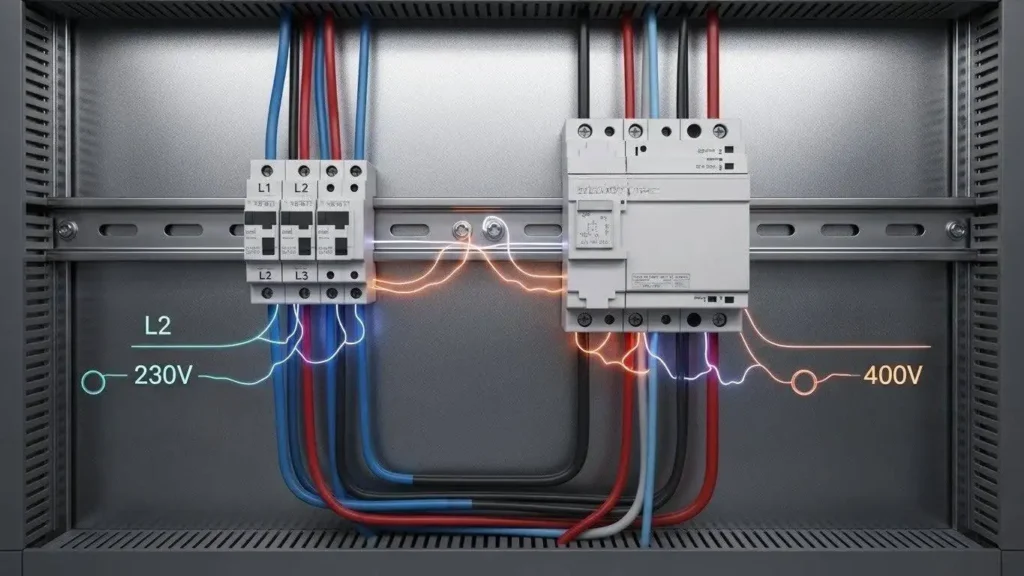
| Voltage Type | Description | Common Value in Türkiye |
|---|---|---|
| Phase–Ground (L–PE / L–N) | Potential of a single-phase line relative to ground | 230 V |
| Phase–Phase (L–L) | Voltage between two different phases | 400 V |
The Uc continuous operating voltage level written on SPDs
refers to the phase–ground voltage value.
Phase–phase voltage is √3 times this value, and there is a 120° phase difference between phases.

poses a serious risk because it ignores the reality of phase–ground voltage.
Square Root of 3 (√3) Formula and Meaning
In three-phase systems, phase–phase voltage is √3 times phase–ground voltage:
230 V × √3 ≈ 400 V
This mathematical fact makes the following principle mandatory in SPD selection:
- SPD selection should be made not according to phase–phase voltage, but according to phase–ground voltage.
- The Uc value must be able to safely withstand the phase–ground voltage to which the system is continuously exposed.
The Most Common Mistake in SPD Selection
This approach is technically incorrect. Because:
- The majority of SPDs are connected to the phase–ground line.
- Lightning impulses and transient overvoltage impulses are directed to ground.
- The SPD should act according to 230 V phase–ground voltage, not 400 V phase–phase voltage.
How to Select the Correct SPD Voltage Level?
Typical recommended voltage levels for TN and TT systems are as follows:
| Connection Point | SPD Voltage Level (Uc) |
|---|---|
| L → PE | 275 V |
| N → PE | Special N-PE SPD |
Using an SPD with a 400 V Uc value may cause protection to activate later and equipment
to be exposed to surges for a longer time.
Technical Risks of Incorrect SPD Selection
- It detects the surge late and activates protection late.
- Invisible damage may occur in sensitive devices.
- An SPD exposed to long-term high voltage may eventually self-destruct.
- Even if the system appears to be operating, it may actually remain unprotected.
A sentence that summarizes this situation:
Protection Levels According to SPD Types
| Area | SPD Type |
|---|---|
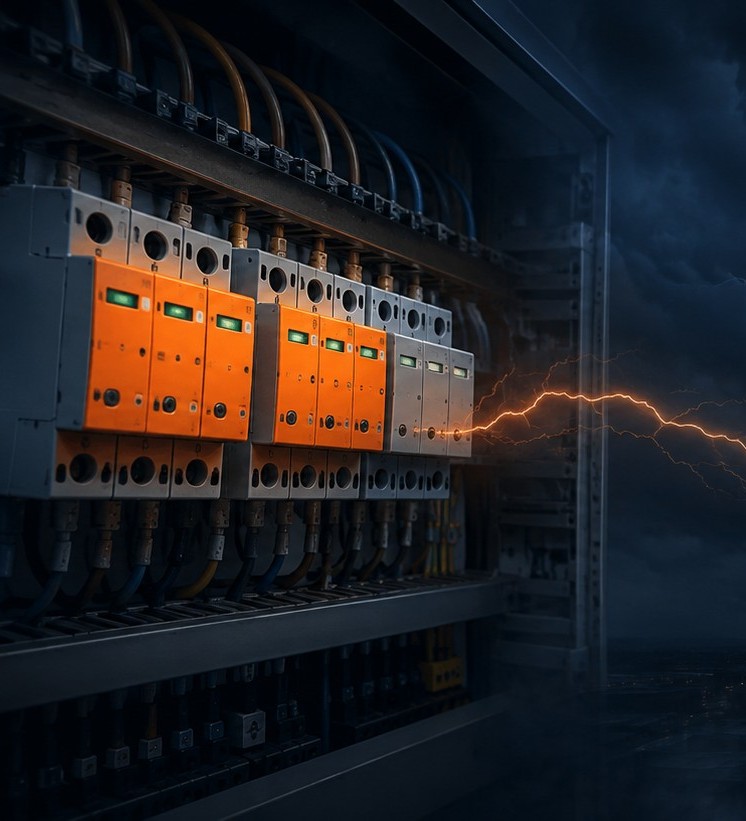
| Main distribution panel | Type 1 + Type 2 |
| Floor panel | Type 2 |
| Device front | Type 3 |
| UPS, data systems | Combined SPD |
YILKOMER Engineering Approach
For YILKOMER, an SPD is
not a “plug and forget” product, but an engineering component positioned through risk analysis.
Main criteria evaluated in projects:
- Grounding impedance
- Neutral structure
- System type (TN, TT, etc.)
- Building class and purpose of use
- Lightning risk and regional conditions
- Device sensitivity
- Energy level and supply scenarios
For each project, a custom SPD configuration is applied;
instead of randomly selecting a product from the catalog, the system is first analyzed and then the SPD is determined.
You Cannot Select an SPD Without Knowing the Voltage
The correct approach in order:
- First define the system
- Then correctly calculate the voltage levels
- As the final step, select the SPD
Every SPD selection made without knowing the square root of 3 (√3) rule creates invisible but serious risks.
YILKOMER manages this process not by guesswork, but by calculation.
Frequently Asked Questions (FAQ)
Why is phase–phase voltage not taken as the basis for an SPD?
Because SPDs discharge the surge to ground and operate according to phase–ground voltage.
The protection level is defined on the phase–ground line.
Is the same SPD sufficient for every panel?
No. For the main distribution panel, floor panel, device front, or data line,
different SPD types and voltage levels must be used.
How can an incorrectly selected SPD damage the installation?
An incorrect Uc value may cause late surge detection, invisible damage in sensitive devices,
and, in the long term, the SPD may self-destruct.
Get a Quote Now
To learn the correct SPD configuration for your electrical system and
to work with the YILKOMER engineering team, contact us.
- Proper SPD selection and sizing
- Risk analysis and site inspection
- Detailed reporting
- Design consultancy