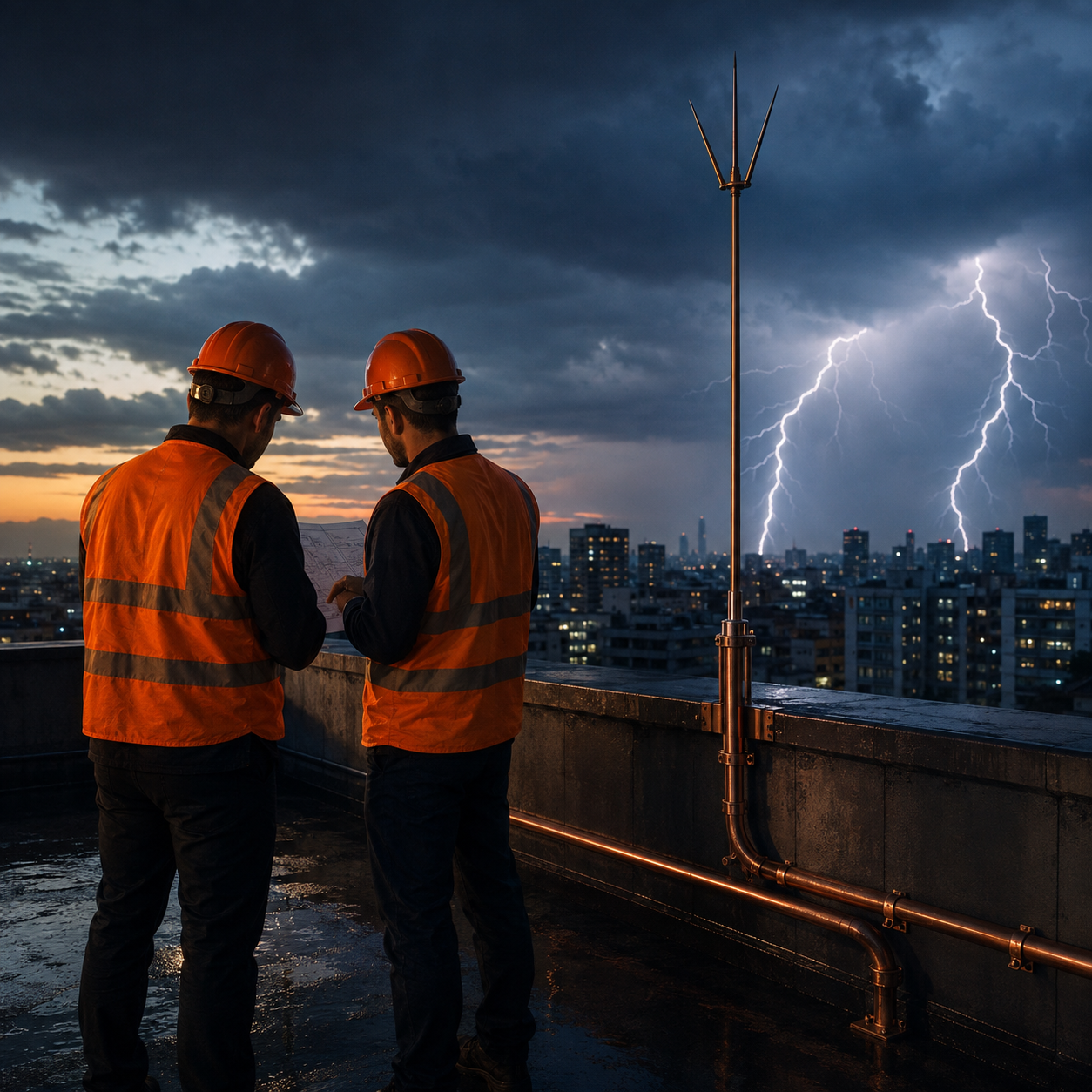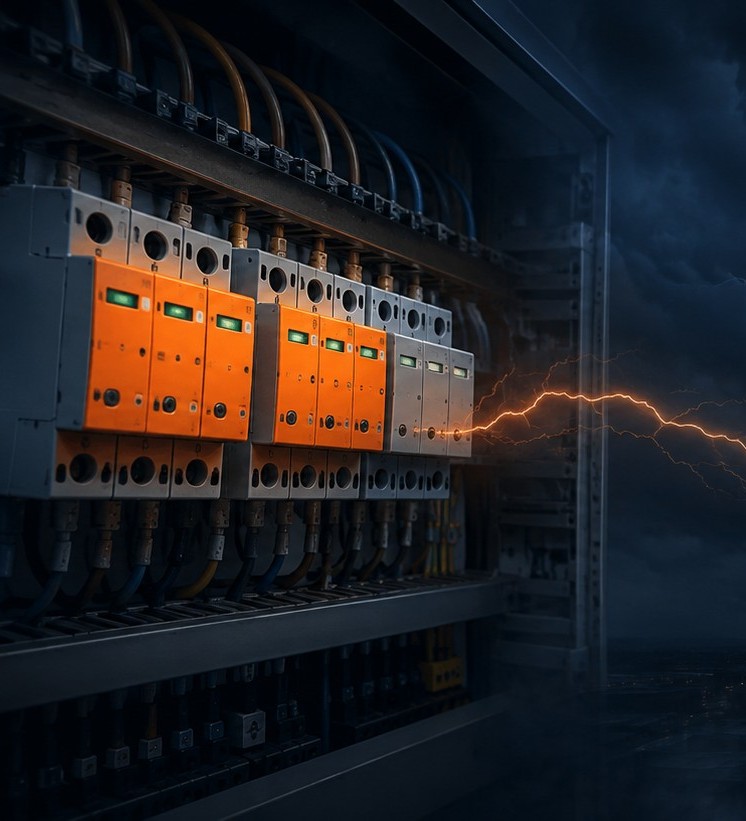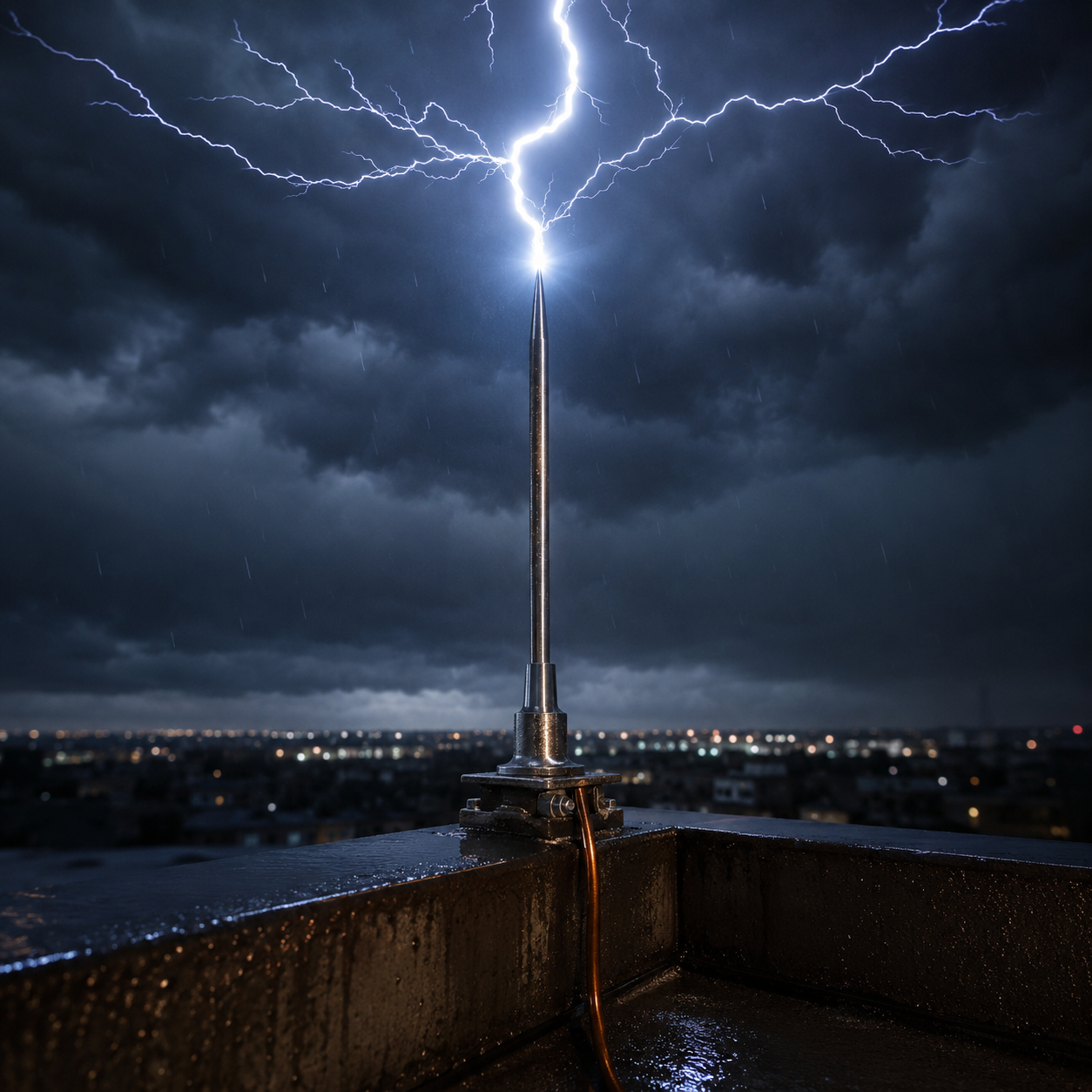
Classical lightning protection systems do not prevent lightning; they determine the point at which it will strike and carry the current to earth in a controlled manner. Lightning prevention systems follow a different approach: by balancing the electric field within the protected area, they aim to forestall the charge accumulation needed for a strong discharge to form.
Yılkomer is the Turkish solution partner for the CMCE (Sertec S.R.L.) system, one of the widely used technologies in this field. At facilities with a chronic lightning problem, a high strike frequency and severe consequences from a direct strike, we position this technology as an additional layer on top of classical protection.
How Does the CMCE System Work?
In the manufacturer’s own terms, CMCE is a passive electric field compensator. It requires no power supply; its operating principle rests on neutralising the movement of atmospheric charge.
The charges that concentrate on the underside of a storm cloud, together with the opposite charges on the ground, create a local electric field. Lightning occurs when this field exceeds a critical threshold.
The many electric field compensators on the product continuously balance the ion movement within the protected area. Each compensator is connected to the earthing system and works simultaneously with the others.
The accumulated charge is carried to earth through corona discharges in the milliampere range, rather than as a single powerful discharge. In this way the polarisation is prevented from building towards a strong discharge.
The system is effective through 360 degrees, within a defined radius around the mounting point. The protection radius is calculated at the design stage according to the geometry of the structure and the mounting height.
Applications and Product Models
The CMCE lightning prevention system is offered in separate models for different structure and site types:
- Boats, marinas and marine craft — A dedicated model for masts, the highest point at open sea.
- Villas and apartment buildings — Compact applications at residential scale.
- Airports — Facilities with large open areas and sensitive navigation equipment.
- Open areas — Car parks, football and sports pitches, school grounds; areas where people gather in the open.
- GSM and antenna towers — Points that attract lightning by their very structure and where continuity of service is critical.
- Commercial cargo ships
- Factories and industrial facilities
- Flammable and explosive atmospheres under ATEX — Sites where the consequence of a single spark is severe.
- Solar power plants — Wide-area installations on open ground.
- Wind power plants — Highly exposed turbine sites.
Standards and Certification
The certification and conformities declared by the manufacturer for the system produced by Sertec S.R.L.:
- INTN (National Institute of Technology, Standardisation and Metrology) certificate
- Manufactured in conformity with UNE-EN (IEC 62305:2012)
- Conformity with UNE-EN 62305-1:2011, UNE-EN 62305-3:2011, NFPA 780:2011, IRAM 2184:2011 and the CTE regulations
- EN 61000-6 (1, 2, 3, 4) 2020 electromagnetic compatibility standard
- Compliance with NBR 5419:2005
- Compliance with NTC 4552:2008 and SANS 10313:2021
- CE, UL, RoHS and ISO quality certificates
- Comparative tests under NF C 17-102
The technology has been under development for over 20 years and is used in numerous field applications.