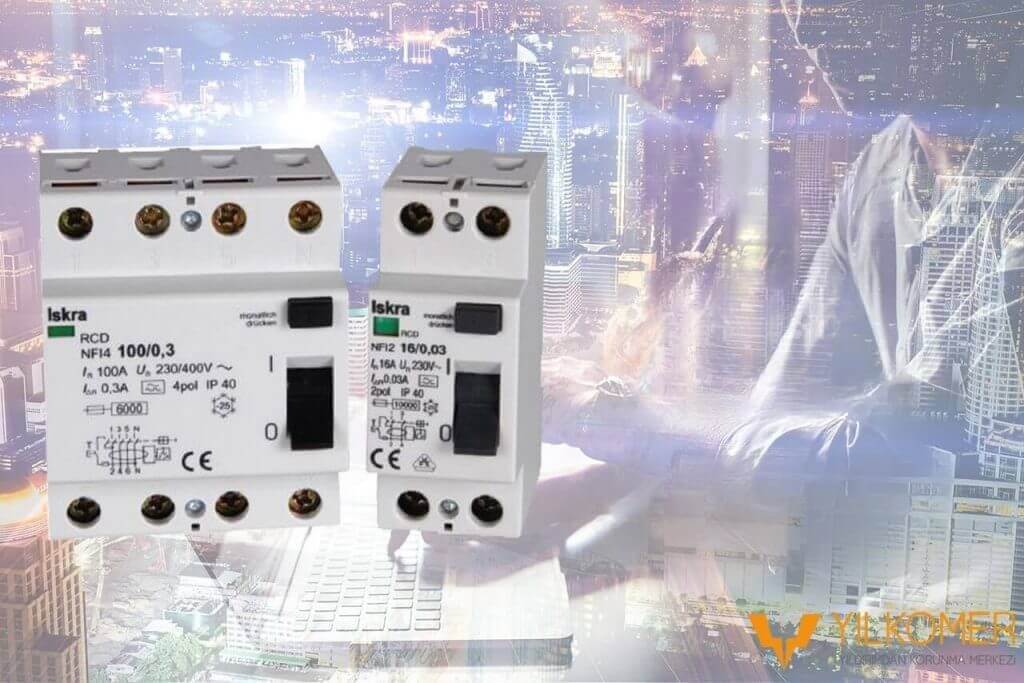
Types and classes of residual current devices, many facilities experience residual current problems due to unnecessary tripping of residual currents; likewise, in many facilities residual current devices are disabled. However, the reason for this is the incorrect selection of the residual current model. If the residual current device type is selected correctly, this problem will be completely eliminated. Many areas where AC type and A type relays are used are incorrect. At these points, F type and DLY type relays that are not affected by frequency changes should be used. In this article, we tried to summarize the types of residual current devices for you in bullet points.

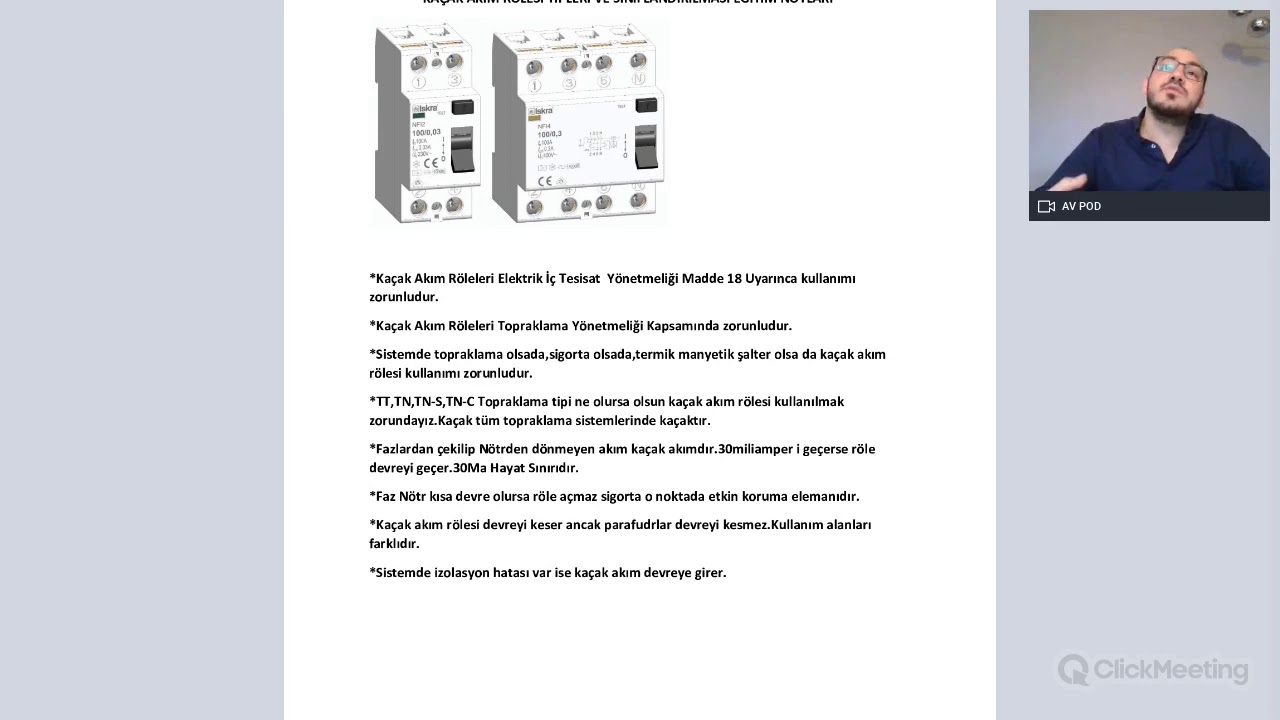
- The use of Residual Current Devices is mandatory in accordance with Electrical Internal Installation Regulation Article 18.
- Residual Current Devices are mandatory within the scope of the Grounding Regulation.
- Even if there is grounding in the system, even if there are fuses, even if there are thermal magnetic circuit breakers, the use of a residual current device is mandatory.
- Regardless of the grounding type TT, TN, TN-S, TN-C, we must use residual current devices. Leakage exists in all grounding systems. Therefore, protection is required.
- Current that leaves the phases and does not return through the neutral is leakage current. If it exceeds 30 milliamperes, the relay trips the circuit. 30 mA is the life limit.
- If a phase-neutral short circuit occurs, the relay does not trip; the fuse is the effective protection element at that point.
- The residual current device disconnects the circuit, but surge arresters do not disconnect the circuit. Their areas of use are different.
- If there is an insulation fault in the system, the residual current device is activated.

HARMONIC – RESIDUAL CURRENT RELATIONSHIP
- Currents above 50 Hz are called harmonics.
- In drive systems, when the motor starts, it draws 8–12 times more current; soft starters, soft starting, star-delta motors are used in parallel with technology, but all of these require high frequency values when operating.
- Our grid is single type: 50 Hz 400 V.
- During starting, in drive motors, 150 Hz 50 mA; 250 Hz 100 mA is required. Harmonic currents generated in these situations cause conventional residual current devices to trip.
- Harmonics are also harmful to the system and can even cause transformer explosions. Therefore, regular harmonic current measurement is required.
- The residual current device trips at this high frequency. Therefore, relays that are not affected by harmonics should be used.
- High currents drawn from drives can jump to the chassis and pass to ground. In this case, they are also perceived as leakage.
- To solve this problem, grounding connections are cut in new machines; the machine body is isolated from ground. In this case, machines will be damaged. This should never be done.
TYPES OF RESIDUAL CURRENT DEVICES
DLY TYPE RESIDUAL CURRENT DEVICE
- DLY contains a low-pass filter. It is the relay that is definitely recommended for drive systems.
- Its frequency resistance value is 20,000 Hz.
- It is absolutely not affected by harmonic currents.
- It is the only option for drive systems.
- It operates not only in 230 V systems but also in 110 V AC/DC, 220 V AC/DC, 400 V AC/DC systems.
- It also operates even if there is no neutral in the system. The toroidal current transformer inside the product surrounds the phases.
- There are also digital display versions. However, displays can deteriorate in hot machines. Therefore, using display versions in main distribution is preferred.
- Remote current monitoring is possible.
F TYPE RESIDUAL CURRENT DEVICE
- It is a more advanced type of A type relays. It prevents unnecessary tripping. These are relays that should exist in many facilities.
- It is not affected by high frequencies.
- It should be used in banks, UPS-fed systems, facilities with instantaneous voltage fluctuations, and systems powered by DC current.
- It is the most ideal relay for facilities with ventilation systems.
- It is the most ideal relay for elevator applications.
- It must be used in machines and systems with DC power supply.
- It has a frequency value of 20,000 Hz.
- It is not affected by voltage drops. The problem of the relay tripping when a welding machine operates is eliminated.
- It is the most correct relay type for residences. Especially offices, plazas, apartments experience problems.
- It is not affected by lightning or grid spikes.
A TYPE RESIDUAL CURRENT DEVICE
- It operates at 50 Hz / 400 V. It trips immediately in frequency changes.
- AC/DC rectified systems.
AC TYPE RESIDUAL CURRENT DEVICE
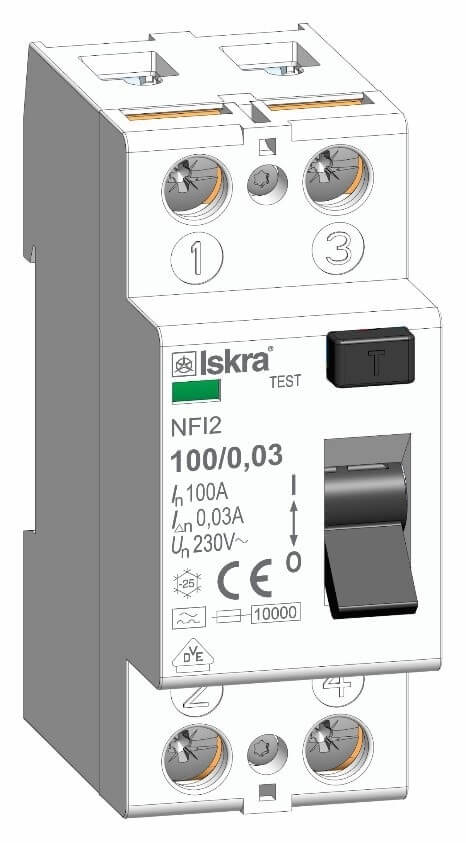
- It is a relay that operates on a sine wave at a fixed value of 50 Hz. It is the simplest relay type.
- It operates only on alternating current.
- It trips immediately in frequency changes.
B TYPE RESIDUAL CURRENT DEVICE
- It can withstand up to 20,000 Hz.
- It is the most ideal relay for DC systems.
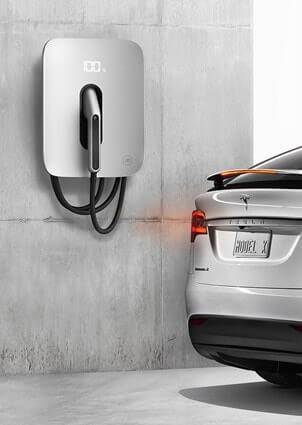
- It is the most suitable relay for solar power plants and electric vehicle charging systems.
G TYPE RESIDUAL CURRENT DEVICE
- They are short-time delayed relays. The maximum delay is 10 ms.
S TYPE RESIDUAL CURRENT DEVICE
- They are short-time delayed relays. The maximum delay is 30 ms.
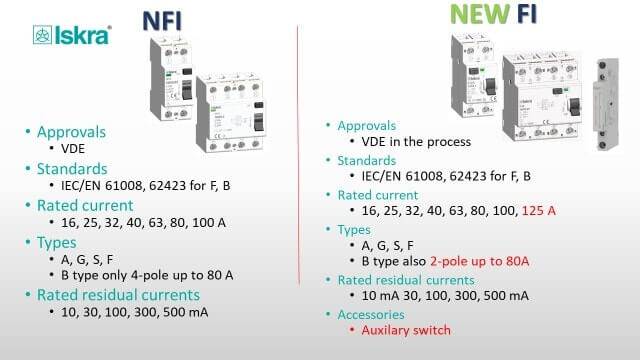
As Yılkomer, we carry out Residual Current Device applications; with free site surveys and applications, we select the correct residual current model in your facility and recommend the most reliable products to you. As Yılkomer, you can obtain the supply of Iskra and DLY branded residual current devices from us.
No human life is more important than cost, and the price difference between products is not very large. The correct relay type must be applied at the correct point!
Yılkomer ‘Protects Your Values’!