
Lightning Risk Analysis Technical Brochure
17 May 2020
Selection of Grounding Products
14 June 2020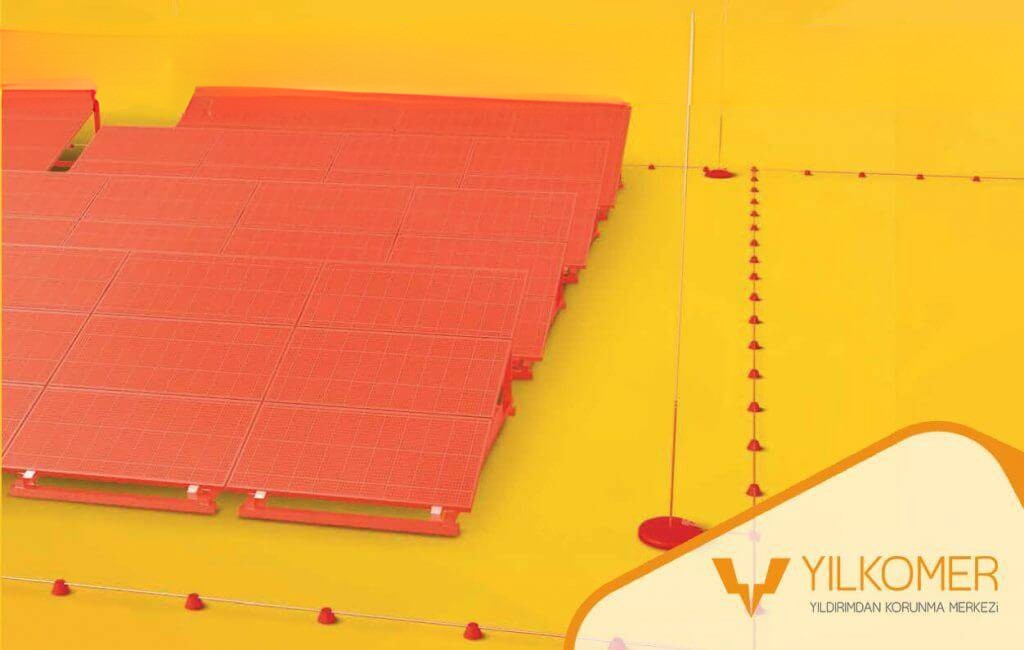
Rooftop solar energy and rooftop PV plants are becoming widespread in our country; in these projects, we wanted to share with you our draft specification in accordance with IEC standards regarding how lightning protection, grounding, and LV surge arrester systems should be. You can download the full text of the specification from the download button located at the very bottom.
ROOFTOP PV LIGHTNING PROTECTION AND GROUNDING TECHNICAL SPECIFICATION
1- GENERAL PRINCIPLES OF LIGHTNING PROTECTION
- The lightning protection project for Solar Panels shall be designed in accordance with IEC 62305 National and International standards.
- The lightning protection project shall include an External Lightning Protection System, LV Surge Arrester System, grounding, and equipotential system. The sizing of system elements shall be carried out by taking into account the lightning risk analysis and the conditions resulting from it.
- The external lightning protection project of the system shall be designed based on the mesh method integrated with passive air terminals designed according to the Rolling Sphere Method or the Protection Angle Method in the light of IEC 62305 standard.
- It is important that the products to be used in the internal lightning protection section are specifically suitable for use in photovoltaic fields.
2- PHOTOVOLTAIC LV SURGE ARRESTER SYSTEM
- All AC, DC, and Data lines in the system that are at risk of damage from sudden overvoltages and lightning shall be protected.
- As a Type 1+2 protection product before the inverter; a product with Safetec Technology, secondary current extinguishing capacity of 40 kA shall be used. In addition, it must be able to operate at temperatures of -40 +85 C and have IP class 20. The product must have a warning contact output feature. It must have compliance certificates for UTE C61-740-51- EN50539-11-UL1449 ed.3 standards. The product must not only have varistor characteristics but must have MOV+GDT hybrid technology and must have the capability to extinguish an unlimited number of surges within its capacity. The recommended brand is Raycap. (Raycap PV PROTEC T1 TYPE 1+2 Series.)
3- PROTECTION OF AC LINES
- Hybrid technology products of Type 1+2 class should be preferred in AC Power Panels.
- For products with 10/350 and 8/20 curves, the Iimp value shall be 100 kA; the Imax value shall be 130 kA.
- The product shall be able to extinguish an unlimited number of surges within its capacity.
- LV Surge Arrester cartridges shall have 3 indicators and a Warning Contact Output.
- Raycap PROTEC T1HS TYPE 1+2 100KA Series is the recommended product.
- The products shall have NF EN 61643-11 standard test certificates.
5- PROTECTION OF DATA LINES
- If communication is provided via poe – cat 6, bidirectional POE, especially Type 3 Ethernet line protection products shall be used for both input and output lines. Raycap Raydat Net6 Series is the recommended model.
- If communication lines proceed in wired form (RS 232 or RS 845), bidirectional communication line protection shall be used on both incoming and outgoing lines to the inverter. Cable entry featured Raycap SLH 4 5v Series is ideal for protecting these lines.
- The Type 3 protections to be used shall not consist solely of semiconductor protection elements but shall also include physical protection products such as GDT and spark gap.
EXTERNAL LIGHTNING PROTECTION SYSTEM
- It shall consist of lightning air terminals, air terminal fixing elements, lightning protection conductors, line holders, four-way and T connection elements, spark gap suppressor, corrosion tape, equipotential bar, and grounding electrodes.
- Protection shall be provided with passive lightning protection elements within the scope of IEC 62305 standard. By performing risk analysis, lightning protection conductors shall be fixed at appropriate intervals within the determined risk group and protection class.
- First, the lightning activity ‘E’ of the structure to be protected shall be calculated. According to the calculated ‘E’ coefficient value, the protection level shall be determined from the relevant table.
- In the light of TSE EN 62305 standard, each solar panel shall be within the protection angle of the air terminals. Each panel support shall be connected via conductors with meshes formed by a ring line circulating over the roof. The air terminals used shall also be connected with the mesh system. The system shall terminate with the grounding electrode. The ring line conductor to be routed on the roof shall be installed using insulated roof supports and all metal components shall be connected to this line. Resistance shall be constant at all system points on the roof.
- The Lightning Air Terminal Systems to be used shall be fixed to the ground in accordance with IEC 62305 standard, and the air terminals and bases shall be compatible with each other. Combined products designed by ensuring moment balance shall be used for the dimensions of air terminals. Yılkomer branded ALMGSİ alloy special air terminals and concrete bases shall be designed in accordance with system characteristics with options such as 8000mm, 3000mm, 1500mm. Air terminals shall have wind test certificates.
- Air terminal bases must have successfully passed the 100 kA lightning impulse test. In addition, they shall be resistant to frost. Expansion elements shall be used on the mesh line routed on the roof.
- All products to be used for connection and fixing purposes shall have IEC standard compliance certificates,
- Additional measures shall be taken with corrosion tape at equipotential and grounding connection points on the roof.
- Additional measures shall be taken with Raycap EPZ 100 spark gap suppressor at equipotential connection points on the roof.
- If grounding terminals emerge from the building foundation ring to the roof, these terminals can be used as grounding and lightning down conductors. However, although it may not pose a risk for the PV system, if there is no LV Surge Arrester system installed inside the building, there will be a risk for all devices throughout the building. Therefore, an LV Surge Arrester application must be implemented throughout the facility. Our recommendation is to provide external grounding down conductors from the building facades, and then to bring this grounding into equipotential with the entire system grounding.
- Type B connection elements shall be used in equipotential bar and ring line connections.
- All products and screws shall be anti-corrosive.
GROUNDING AND EQUIPOTENTIAL SYSTEM
- Grounding electrodes shall comply with VDE 0185305 (IEC 62305) standards. As rooftop grounding conductors, ALMGSİ alloy soft conductors or hot-dip galvanized strips with 70 micron coating may be used. Corrosion-preventive tape shall be used at every connection point in the grounding system.
- It is appropriate to use resistance reducing chemicals at points where resistance remains high. However, whenever possible, natural grounding resistance should be achieved for system lifetime. The use of copper electrodes and copper conductors underground and exothermic welding is recommended.
- Grounding electrodes shall be interconnected with the help of grounding conductors.
- Manholes shall be installed at the points where electrodes are driven to allow easy intervention during operation. In addition, measurement points shall be created using equipotential bars.
- Grounding values shall be measured by the electrical consultant and kept under regular control.
- In the light of the existing facility structure, it is recommended to form a ring line around the structure and create equipotential in the system together with a stainless steel bar.
- The bars to be used shall comply with the descriptions in VDE 0100 Section 410 and Section 540, and shall comply with VDE 0185-305 standard. The bars shall have stainless steel (V2A) characteristics. It is recommended to use a bar with 10 connection points, 40 mm width, 246 mm length, and 6 mm height.
- The lightning protection system is completed as a result of the integration of the grounding system, external lightning protection system, equipotential system, and internal lightning protection systems. Therefore, especially at points where external lightning protection is applied, the use of surge protective devices is mandatory. Systems that do not have a complete LV Surge Arrester system are not compliant within the scope of Internal Installation Regulation Article 43.
Click to download the brochure. Rooftop PV Lightning Protection and Grounding Technical Specification