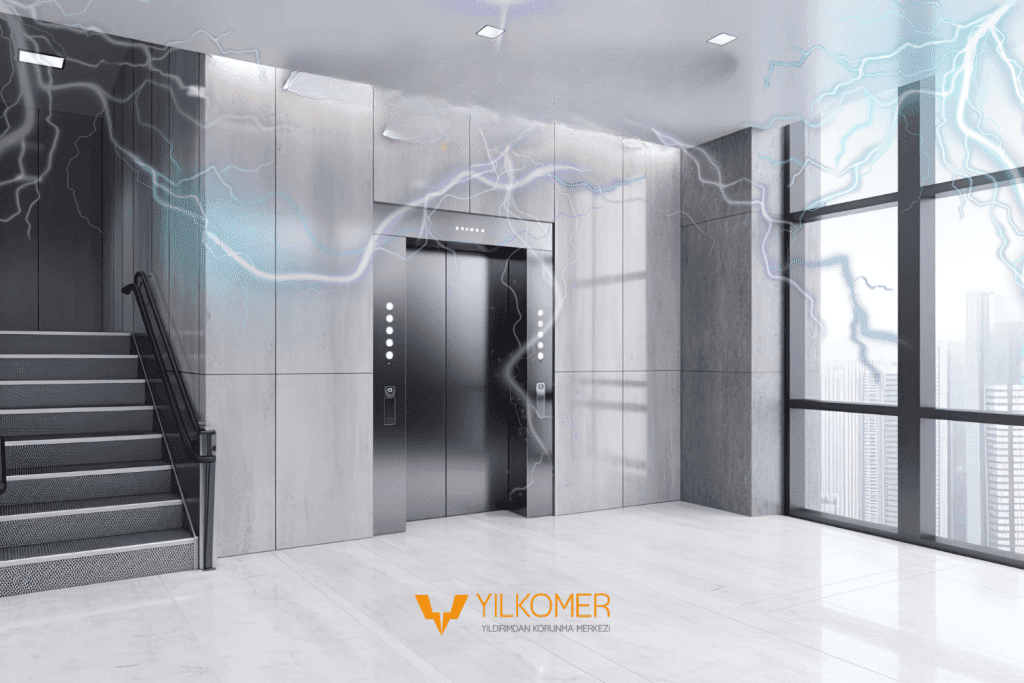
Protection of Elevators Against Lightning and Sudden Overvoltage
Today, the fact that elevators and similar systems contain highly sensitive electronic components increases the importance of lightning protection systems. Everyone is familiar with the fear of being trapped in an elevator. Proper lightning protection devices can help prevent VFD and control panel failures, enabling elevators to operate during storms and sudden shocks. Especially for commercial and high-rise buildings, preventing elevator failures ensures peace of mind for everyone. Lightning, sudden overvoltage surges, switching surges, and harmonics can cause damage to elevator boards and automation systems. Surges coming from both DC and AC sides can cause serious damage to systems. Therefore, it is essential to take the necessary protection measures.
Methods for Protecting Elevator Systems
There are many reasons showing that protecting elevator systems and related components (such as electrical panels, elevator controls, motors, variable frequency drives (VFD), safety interlocks, fire curtains, and other sensitive electronic devices) with LV surge protection systems is an effective solution. LV SURGE ARRESTERS prevent hardware damage that may occur due to transients and shocks on both power and signal lines, increasing uninterrupted operation as well as system and data reliability. In addition, surge protection systems are suitable for all facilities or loads of 1000 volts and below.
Lightning Protection in Elevator Modernization
Advances in elevator technology have played a critical role in the emergence of high-rise buildings that define our city skylines. However, to support infrastructure development and meet social needs, improvements are required in elevator safety, durability, quality, space efficiency, and performance. Therefore, selecting the correct Lightning Protection Device, namely the LV surge arrester, is important to reduce unnecessary downtime. Modernization projects may often seem like an expensive and time-consuming process. Before starting such a project, a comprehensive assessment is carried out to evaluate the performance of the existing system. Once this information is obtained, it is evaluated whether modernization is necessary and, more importantly, whether it makes operational sense. Of course, the most important consideration should be the safety of passengers, maintenance personnel, and the elevator system. An up-to-date, more modern, safer, and more reliable elevator is clearly the preferred outcome. However, an important safety consideration that is often overlooked is surge protection within systems. The use of the correct surge arrester can reduce downtime and lower maintenance costs. It is also mandatory within the scope of the IEC 62305 Standard.
Importance of Lightning Protection
Elevators generally have a service life of more than 20 years; however, during this period, their performance may decrease, maintenance costs may increase, energy consumption may rise, and the risk of downtime may occur. Modernization can make elevators more energy efficient and reduce energy costs by feeding energy back into the building instead of dissipating wasted energy as heat when the elevator moves in an unbalanced direction. However, as the hardware and software used in elevator applications advance, this has introduced an entirely new set of problems and maintenance requirements. Although today’s hardware and software are more reliable than ever, they are extremely sensitive to power fluctuations. High-voltage shocks are generally covered by lightning protectors. However, traditional surge arresters do not account for low-level transient shocks that can occur countless times throughout the day. These additional peaks and dips on the main waveform create a complex situation for sensitive devices and machinery and can damage electrical equipment. This can lead to repeated random failures, lockups, and loss of programming, such as in Human-Machine Interfaces (HMIs) used in Destination Control Systems on each floor. Therefore, a more sophisticated transient protection system is required to protect the electrical control system, VFD, and elevator controller against transients. When the correct surge arrester system is used, downtime and maintenance costs can be eliminated.
Are Elevators Sensitive to Lightning Shocks?
Although lightning shocks are generally rare, they can affect both commercial and residential elevators. Lightning shocks usually occur when line voltage rises above normal voltage. Shocks often occur together with power outages; however, shocks are essentially sudden increases in electrical currents. Nevertheless, surges tend to disable protection features more than other situations. Typically, when a power outage occurs and power returns within a few seconds, elevator power will also return. How the elevator responds may also depend on the type of elevator. Some older elevators have fewer components and are less sensitive to power fluctuations. Older elevators generally have fewer power-generation features, meaning that a larger power outage than a typical power shock may be required to stop the elevator. New elevator systems are somewhat different because they generally offer more power protection. Most newer traditional elevator models have motor drives with minimum and maximum input voltage detection. This means that at a certain percentage change, the motor drive will shut down to protect the elevator and motor.
The Need for Lightning Protection in Elevators
Although the need for lightning protection in elevators is not common, it can occasionally affect commercial and residential elevators. Lightning shocks usually occur when line voltage rises above normal voltage. Shocks often occur together with power outages; however, shocks are essentially sudden increases in electrical currents. Nevertheless, shocks tend to disable protection features more than other situations. Typically, when a power outage occurs and power returns within a few seconds, elevator power will also return. How the elevator responds may also depend on the type of elevator. Some older elevators have fewer components and are less sensitive to power fluctuations. Older elevators generally have fewer power-generation features, meaning that a larger power outage than a typical power shock may be required to stop the elevator. New elevator systems are somewhat different because they generally offer more power protection. Most newer traditional elevator models have motor drives with minimum and maximum input voltage detection. This means that at a certain percentage change, the motor drive will shut down to protect the elevator and motor. Many new elevators will also include other safety features such as emergency battery-backed lowering systems, emergency automatic in-car lighting, emergency alarms, and emergency start and stop buttons. All commercial elevators must have a functioning radio communication system.
Recommended Surge Arresters for Lightning Protection
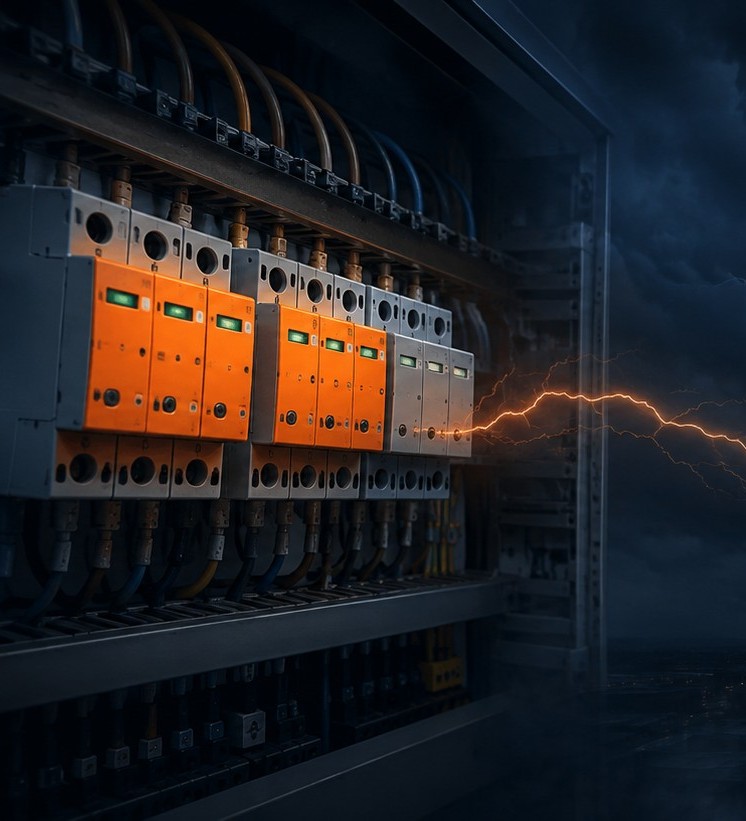
A lightning protection device recommended for use in elevators should be a high-quality and reliable product. Lightning protection devices are designed to prevent overvoltages and transients from damaging the elevator system. These devices protect electronic components within the elevator system, preventing failures and ensuring uninterrupted operation. Lightning protection devices can be used for both power lines and signal lines. These devices make elevators more reliable and durable. In addition, they reduce maintenance costs and increase energy efficiency. Lightning protection devices should be supplied by a high-quality manufacturer and selected according to the needs of the elevator.
- Main Panel: RAYCAP PROBLOC TYPE 1+2+3 100KA 3P+N SERIES
- Sub Elevator Panels: RAYCAP PROTEC C TYPE 2+3 40KA 3P+N SERIES
- For Sensitive Protection of VFD and control systems: RAYCAP DMDR 20 DC LINE PROTECTION
- For communication lines: RAYCAP SLH SERIES TYPE 3 Surge Arresters
It is clear that elevators need lightning protection systems. Elevators with sensitive electronic components can be exposed to serious damage due to transients and shocks. Therefore, using the correct lightning protection devices is important. Lightning protection devices protect elevator systems and related components from transients and shocks originating from power and signal lines. This ensures uninterrupted operation, increases system and data reliability, and prevents hardware damage. It is also important not to overlook lightning protection systems in elevator modernization projects. Lightning protection systems designed and integrated according to the needs of high-rise buildings make elevators more reliable, energy efficient, and durable.
The use of LV Surge Arrester systems for elevators is extremely important. As Yılkomer, we are always happy to support you in selecting the correct surge arrester. With our Raycap series LV Surge Arrester products, we are pleased to support you in protecting elevators.
You can contact us for product selection and details.
Do not forget, Yılkomer ‘Protects Your Values!’