In solar systems, the subject of Overvoltage and Lightning Protection must be summarized under 4 main sections, and we must flawlessly implement these 4 items in facilities. The four-level protection principle is among the golden rules that will keep solar power plants operational for many years. Listed under main headings;
1- EXTERNAL LIGHTNING PROTECTION SYSTEM
2- LV SURGE ARRESTER (INTERNAL LIGHTNING PROTECTION) SYSTEM
3- GROUNDING SYSTEM
4- EQUIPOTENTIAL BONDING SYSTEM
It is important that these four items are designed in accordance with IEC standards, that the products are selected based on relevant test criteria, and that the applications are carried out by considering long-term durability. In this section, we will discuss the basic installation principles of these four systems.
1- EXTERNAL LIGHTNING PROTECTION SYSTEM
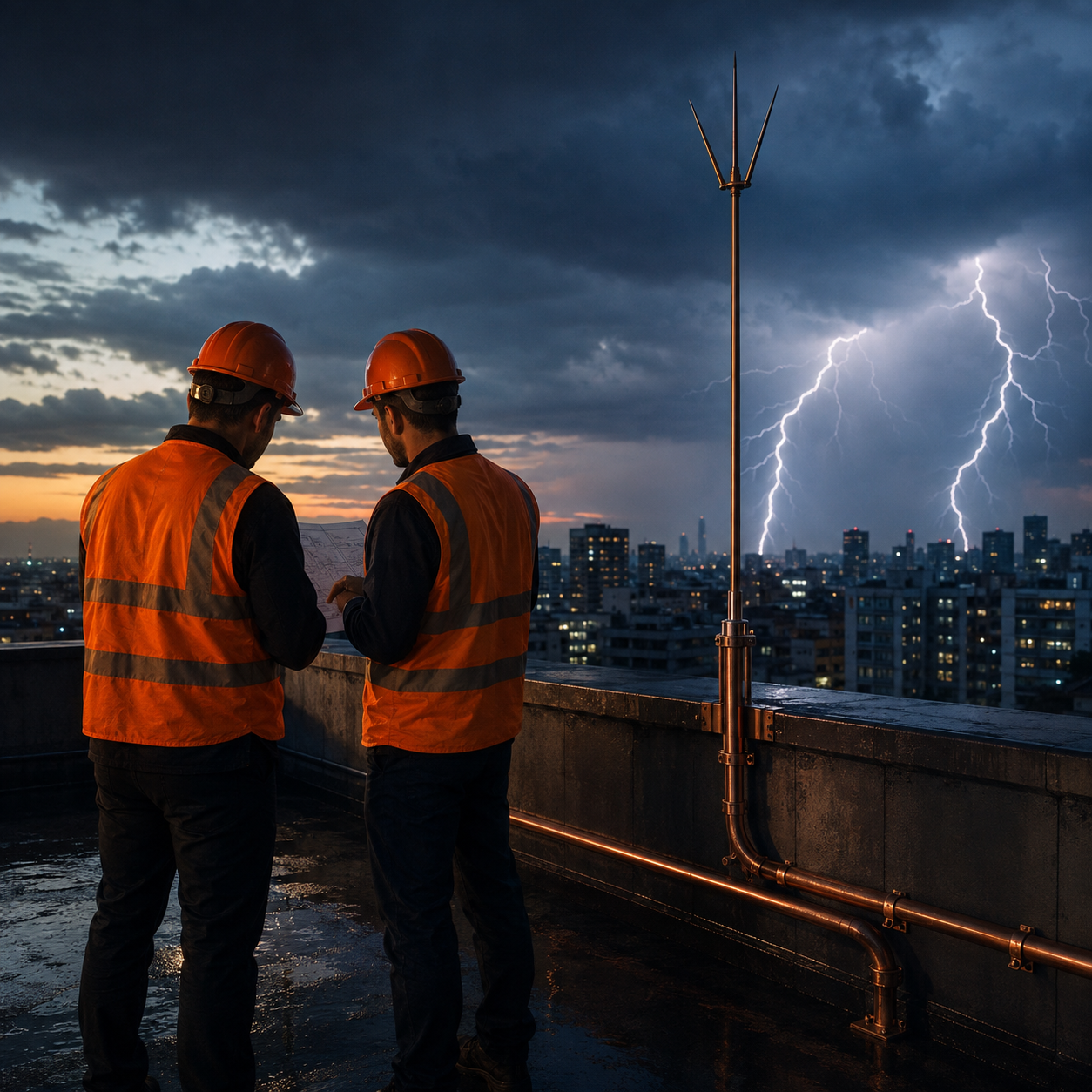
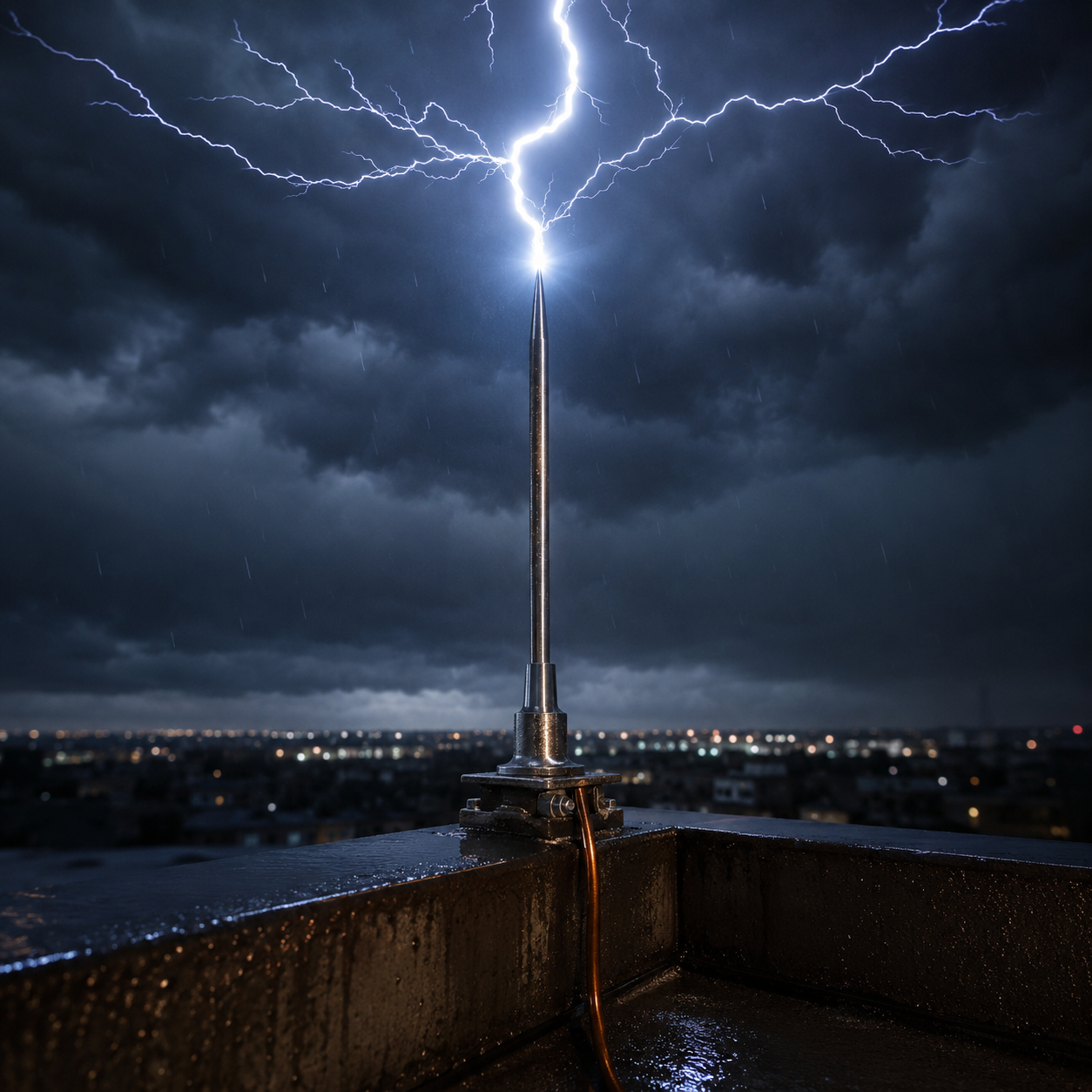
External lightning protection systems are very important systems that keep the facility operational against the direct effects of lightning strikes; protect panels and other system components against physical effects; and protect personnel working and operating in the field. Within the scope of the IEC 62305 standard, the external lightning protection system, which uses the rolling sphere method and protection angle methods, must be designed as a result of detailed engineering calculations. The reason passive air terminals are preferred in solar power plants is to both reduce risk and establish more reliable systems. For this reason, lightning rod systems are not recommended in solar fields within the scope of the IEC 62305 standard. Systems calculated with protection angles using air terminals are placed behind the panels, while systems that create a protection area according to the rolling sphere method are placed around the field perimeter.
Before carrying out the external lightning protection design in solar projects, a lightning risk assessment must обязательно be performed. Risk analysis, which can also be carried out using risk analysis software, includes data such as location information, soil survey data, facility dimensions, MV and LV lines around the facility, surrounding structures, mountainous areas near the facility, lightning incidence angle, and regional lightning density. As a result of these data, the lightning risk of the area where the solar system will be installed is calculated. As a result of the calculation, four levels appear. The risk table, listed as Level I, II, III, and IV, provides protection angles and rolling sphere radii. The radius to be used in the rolling sphere method is directly compared with the risk analysis. The table provided to us by the IEC 62305 standard is shown below.

After determining the protection level for the solar field, the external lightning protection system to be installed is defined. Whether the system is selected as panel-back protection or area protection, the most important point to consider is the S separation distance. Lightning down conductors and system components must be positioned at least the calculated ‘s’ separation distance away from the panels. The S separation distance can be calculated using the formula below. An example calculation can be made as follows.
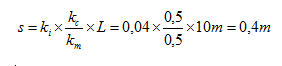
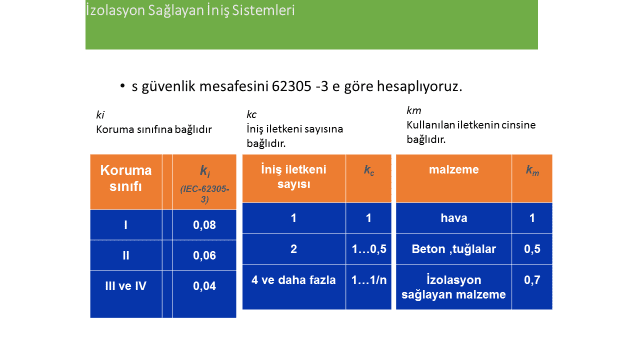
The ‘s’ separation distance is also important in rooftop systems;

Lightning protection designs for rooftop and ground-mounted installations show similarities. At this point, it is also important to calculate the shading factor for panel-back installations. In systems designed according to the rolling sphere method, fences and corner points can emerge as the most ideal areas for positioning air terminals, considering equipotential bonding.

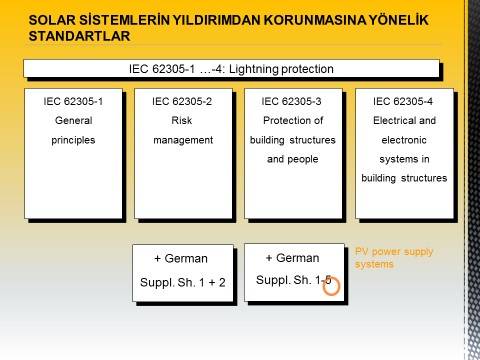
According to TS EN 62305-2 (Protection Against Lightning – Part 2: Risk Management), published by the Turkish Standards Institute in June 2007, there is no calculation method regarding lightning protection for photovoltaic (PV) systems installed outside buildings. However, in 2010, Section 5 titled Photovoltaic Power Supply Systems was added to TS EN 62305-3 (Protection Against Lightning – Part 3: Physical Damage to Structures and Life Hazard).
In this added section, photovoltaic power plants larger than 10 kW installed in open areas shall be equipped with lightning protection according to Protection Level IV (R:60 m). Since lightning protection will be installed, an additional risk assessment calculation is not required. In solar systems, risk studies carried out according to the rolling sphere method generally result in Level III and IV, allowing the rolling sphere radius to be taken as 45 meters and 60 meters.
In the protection angle method, the protection angles of air terminals placed behind the panels must include the panels within the protection zone. At this point, the ‘s’ separation distance mentioned above is again important.
As a result, if the protection angle method is applied in the lightning protection system design of solar panels, panel-back air terminals are used; if area protection is preferred, tripod air terminals up to 8000 mm, calculated according to the rolling sphere method, are used. Panel-back air terminals may exceed the panels by 50 cm due to the shading factor, and base-fixed air terminals can be used for every 5 panels. The equipotential bonding concept, which we will explain in detail, is extremely important in external lightning protection systems. All external lightning protection system groundings must be included in an equipotential system together with the main facility grounding. During the equipotential bonding phase, spark gap surge arrester systems can be used.