As the Lightning Protection Center, we provide consultancy to many insurance companies and banks on this subject. However, in order to reach points we cannot directly access, we wanted to inform relevant parties by publishing this content. You can always contact us for your questions and technical support.
In solar investments, we strive at every opportunity to explain incorrect and insufficient practices against Sudden Overvoltage Surges in terms of standards and engineering calculations. These risks can create major problems for banks providing loans, insurance companies committing to cover damages, and most importantly, investors aiming for sustainable income. No one can guarantee that a facility planned to operate for 20 years, with a return period of 7 years and located in open terrain throughout this time, will not be struck by lightning or affected by grid-induced sudden overvoltages. Indeed, when we look at Turkey’s risk map, locations where solar investments are intensively carried out are unfortunately highly effective points in terms of lightning. Incorrect applications raise concerns for future processes. In addition, electrical surges and coupling effects can occur anywhere in our country at any time. To elaborate on the coupling effect, a lightning strike that does not directly hit our facility but strikes a very distant point can be directed toward our facility due to differences in soil resistivity. Especially in open terrain, we frequently encounter coupling effects. All these risks cause our investments to suffer electrical damage, frequent production stoppages, renewal of investment equipment, and most importantly, loss of time. Naturally, banks and insurance companies that will assume financial liabilities in this matter will also go through a difficult process.

So how should the correct protection system be provided in PV Projects? What should insurance companies and investors pay attention to in the projects they support? The norms and standards on this subject are quite clear. First of all, all calculations and designs must be carried out within the scope of IEC 62305, IEC 50164, and IEC 61643 standards. This is a 20-year investment and is expected to remain operational electrically. At this point, the first step is to prevent the risk of CORROSION and to design the grounding system very accurately. This first step will also ensure the durability of the external lightning protection system. The equipment used in grounding design must comply with IEC 50164 certification and have anti-corrosive properties. The corrosion effect prevents resistance from remaining stable and causes the EQUAL POTENTIAL system we provide through grounding to disappear, allowing current flows. After the selection and application of grounding equipment in the facility, equipotential bonding must be ensured throughout the facility. This will be the most effective way to prevent the flow of sudden overcurrents. At every point of the facility—fences, external lightning protection, table legs, transformers, etc.—the resistance difference should not exceed 0.2 ohms. To achieve this, engineering studies must be carried out effectively.

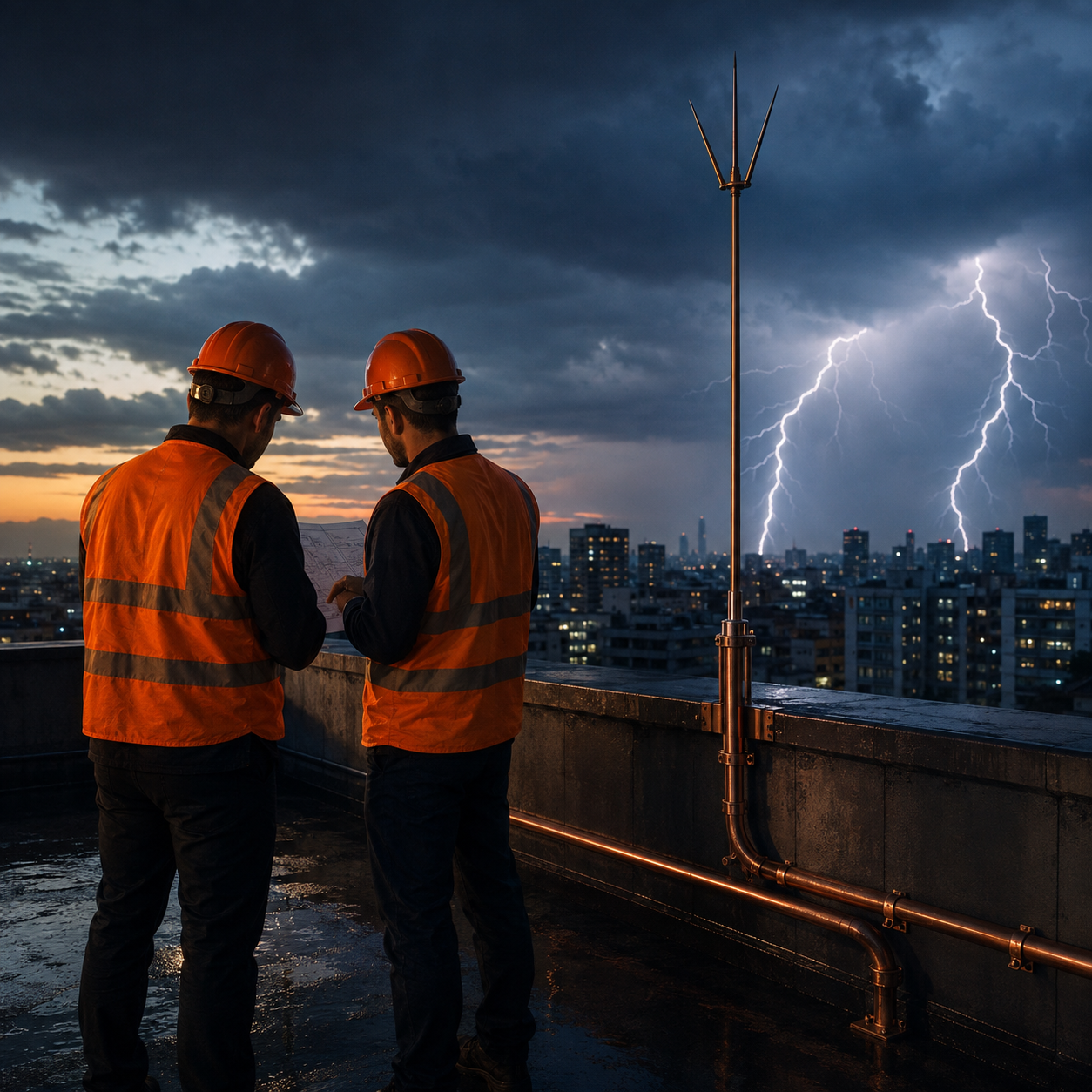
Within the framework of IEC 62305 standards, we do not recommend the use of lightning rods in solar investments. Briefly explaining the reason, cumulonimbus clouds that cause lightning in open terrain can more easily prefer ion-emitting systems. We prefer to establish a system that becomes active when lightning actually strikes our facility. Partial Faraday designs made with non-ionizing lightning air terminals according to the rolling sphere method are the most accurate protection method for solar power plants. Instead of lightning rod systems, we strongly recommend providing protection around the facility with long air terminals by paying attention to the S protection distance in order to minimize insurance and bank risks. This issue should be taken very seriously in the insurance concept of solar investments. External lightning protection systems should also be included in equipotential bonding with damping spark gap surge arresters. However, an external lightning protection system is beneficial for protection against the physical effects of lightning. It captures the direct lightning and transmits it to the ground, preventing it from striking the system. However, it does not provide electrical protection. This stands out as the most common problem we encounter due to lack of information. Most facilities are protected only by lightning rod systems by EPC companies, and the number of damages reported to us is increasing day by day. To protect against electrical effects, surge arresters must be used on DC (inverter protection), AC, and data lines.

This issue is also an important point in preventing the coupling effects explained above. However, when using surge arresters, B+C class products with 10/350 ms characteristics and maintenance-free (vg) technology should be preferred. Insurance companies should pay attention to this point when insuring inverters. Yes, some inverters are sold with built-in surge arresters, but they only contain Class C products. Class C products do not protect against lightning. In addition, in projects using combiner boxes, DC AG SURGE ARRESTERS should be used as B+C class. The Surge Arrester system can be integrated into the system later with an external junction box.