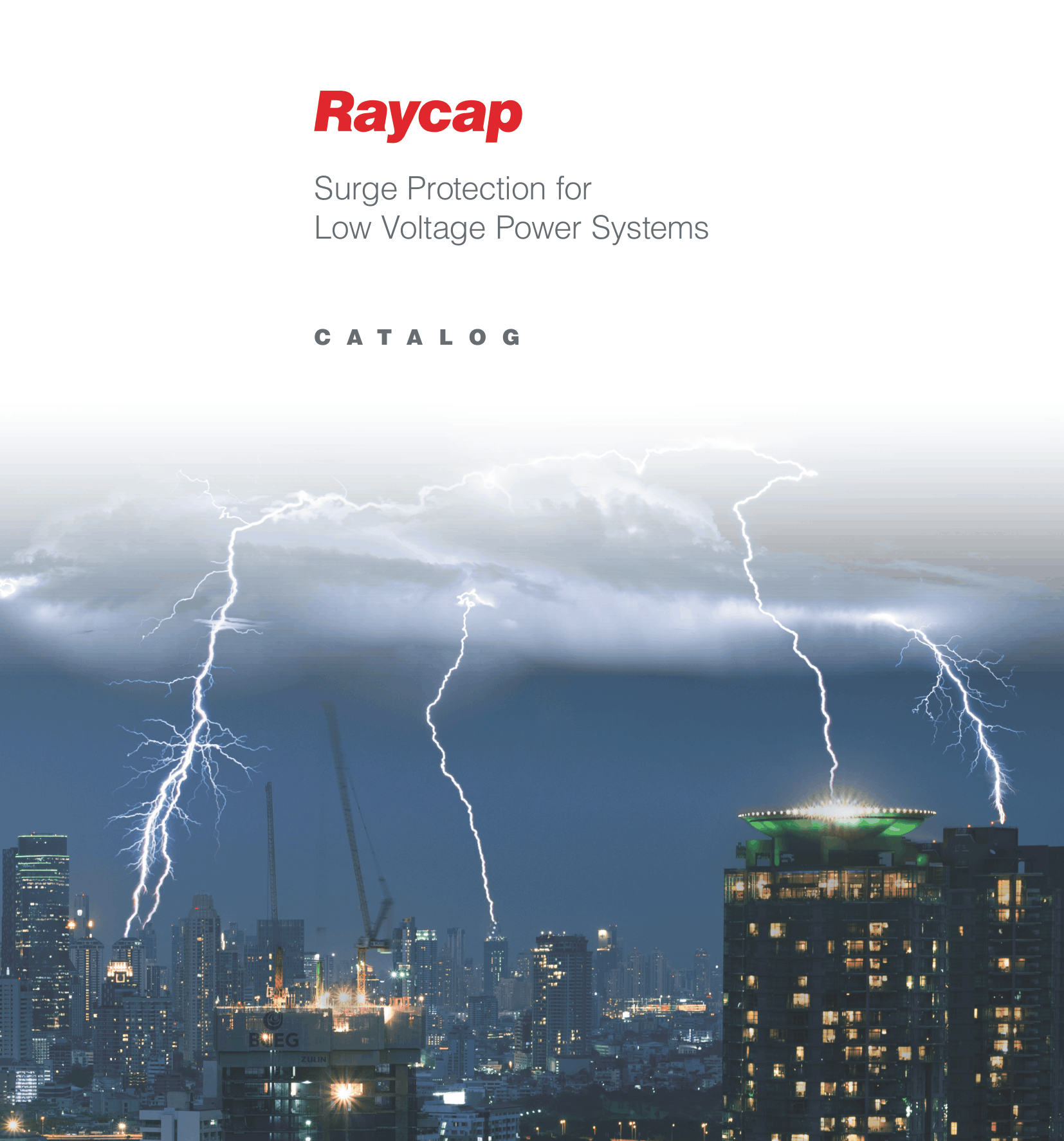
More than 2 million lightning strikes occur in our country in a single year.
The burning and flammable effects of a lightning strike directly on a PV system building or on panels in an open field cannot be ignored. All systems face fire risks, and all electrical components, including cards, communication modules, and transformers, may be damaged. In the event of a lightning strike, sustainable energy production would stop, causing serious problems and financial and emotional distress. All components in PV DC and AC panels, especially semiconductors, can burn out.
You may also be interested in: Discounts on PV Plant Insurance

Why Should We Use a Lightning Protection System in a PV System?
- To get the expected return on investment, the PV plant must operate reliably for 20 years.
- During this 20-year period, repair and damage costs for plant equipment should be minimal.
- Insurance companies significantly increase premiums for a plant exposed to lightning in future years.
- The cost of not producing energy for a single day exceeds the cost of the entire lightning protection system. Most damages caused by lightning cannot be compensated in one day, increasing overall losses.
- The electrical effect of lightning and sudden overvoltage waves causes a high probability of system damage. The daily risk for an industrial facility increases by 70% if the PV plant is in an open field or on a rooftop.
- In locations with dense PV installations, the number of thunderstorm days increases proportionally.
- Incorrectly implemented protection in existing plants results in complaints and requests for redesigning the lightning protection system for operational projects.

- IEC 62305 1-2-3-4 Standard and other national and international standards define all steps for lightning protection. Implementation is technically mandatory.
- A lightning strike can reach 200 kA and 28,000°C peak. Its electrical and physical effects cannot be ignored. Correct systems must be installed to prevent accidents during storms.
- For occupational safety, a lightning protection system must be installed both during construction and operation to protect personnel.
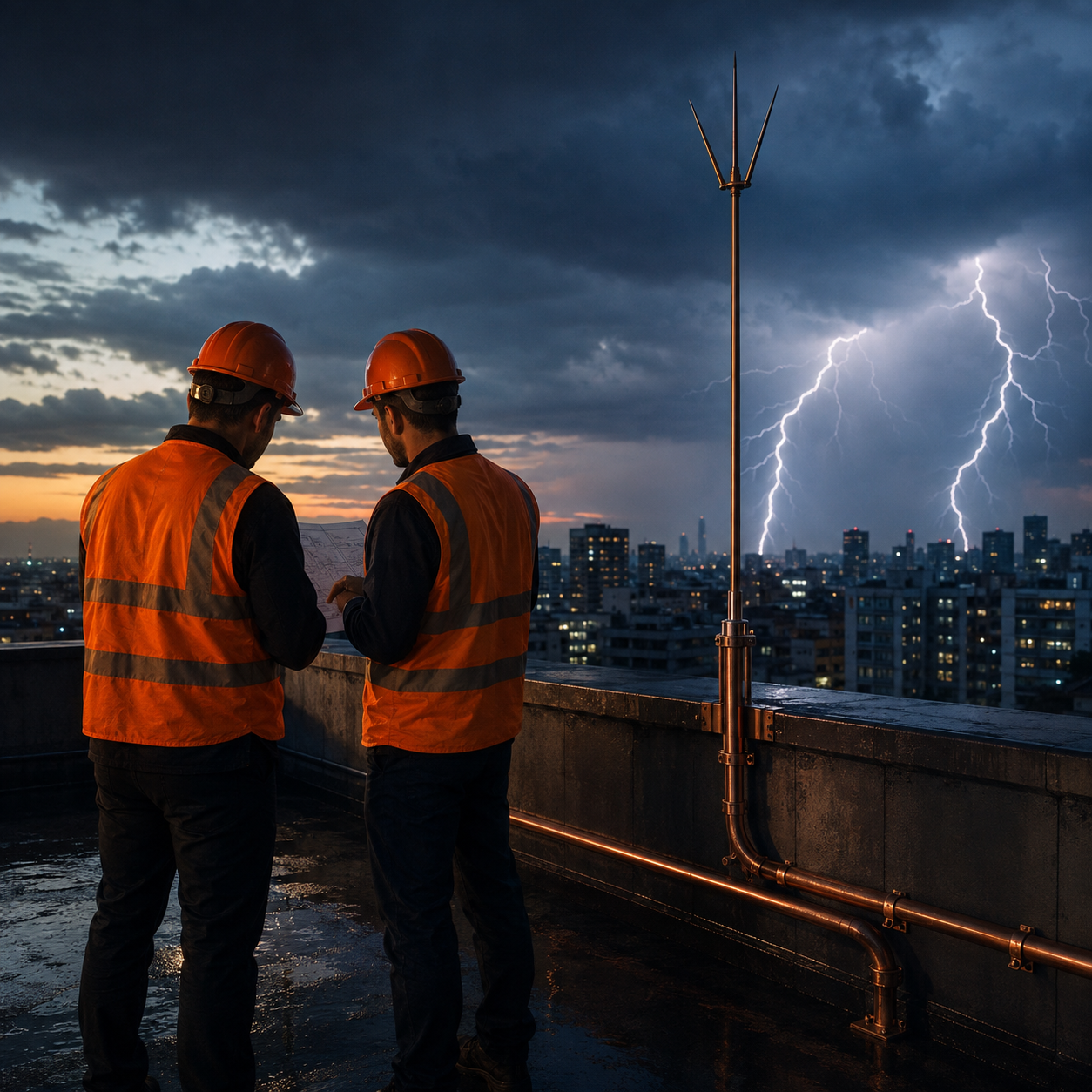
- An external lightning protection system is crucial for protecting the plant from direct strikes. The VDE 0185-305 (IEC 62305) standard clearly explains this.
- Statistics show that a lightning strike can cause up to 30,000 EUR in damages to panels, inverters, and other equipment in a plant.
- Sensitive systems like dataloggers may be damaged by lightning, and secondary follow currents can also harm main systems.
- Compared to lightning, grid-originated surges, harmonics, and sudden voltage spikes often occur in field installations. Events occurring within 25 nanoseconds can disable systems and stop energy production.
- If an external lightning protection system is not properly designed for a direct strike, serious irreversible damage can occur, potentially requiring replacement of cabling and panels.
- Strikes occurring within 2 km may be directed to the plant due to resistance differences.

Important Standards for Lightning Protection in Solar Systems
External Lightning Protection System
- VDE 0185-305-3 (IEC 62305-3): Standard for Lightning Protection in Buildings
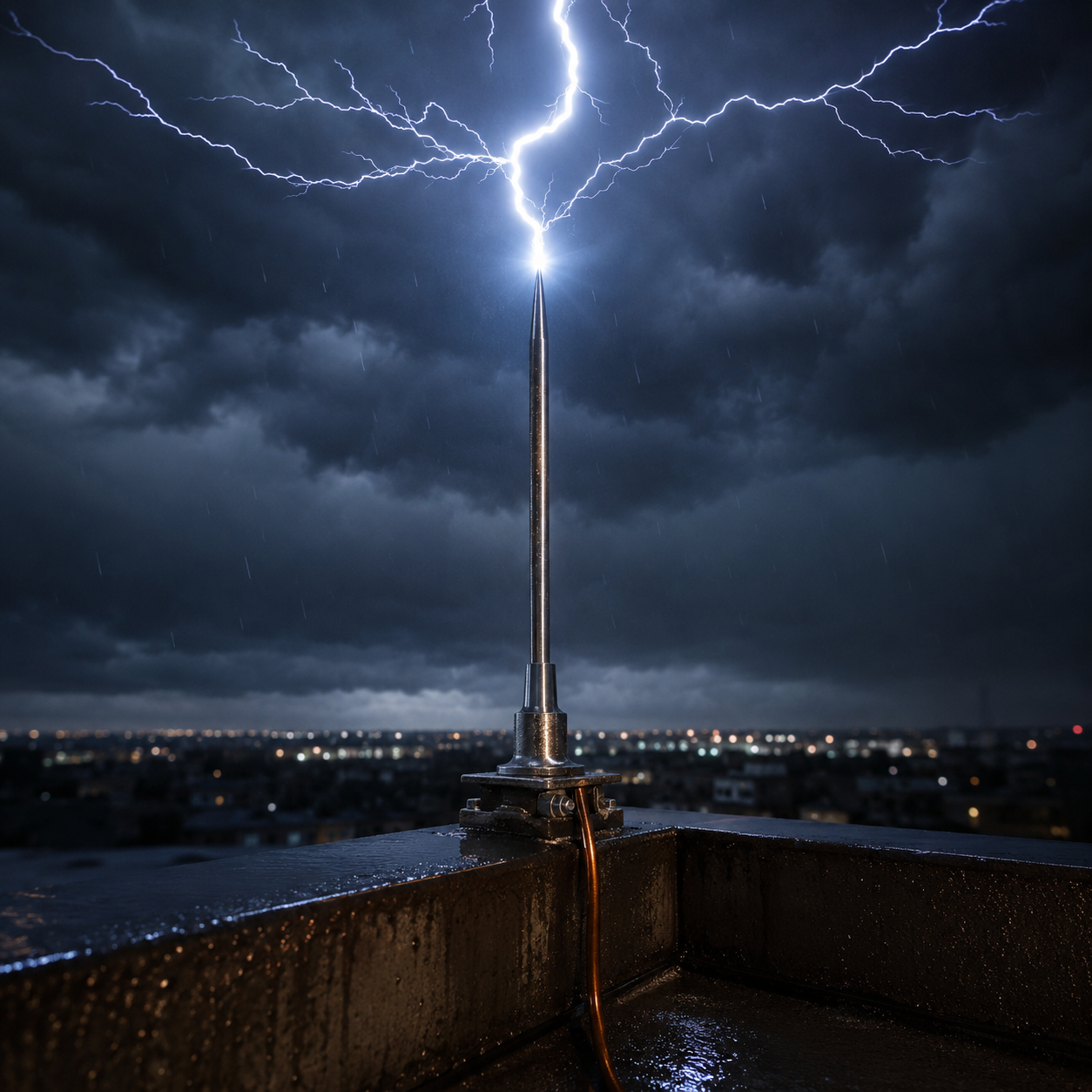
For photovoltaic systems, protection should be provided with Passive Capture Rods using the rolling sphere or protection angle method. The standard does not recommend conventional lightning rods for solar systems. Protection design should follow site-specific risk analysis and project planning.
Internal Lightning Protection (AG Surge Protector Systems)
- VDE 0185-305-4 (IEC 62305-4): Protection of Electrical and Electronic Systems from Electrical Effects of Lightning
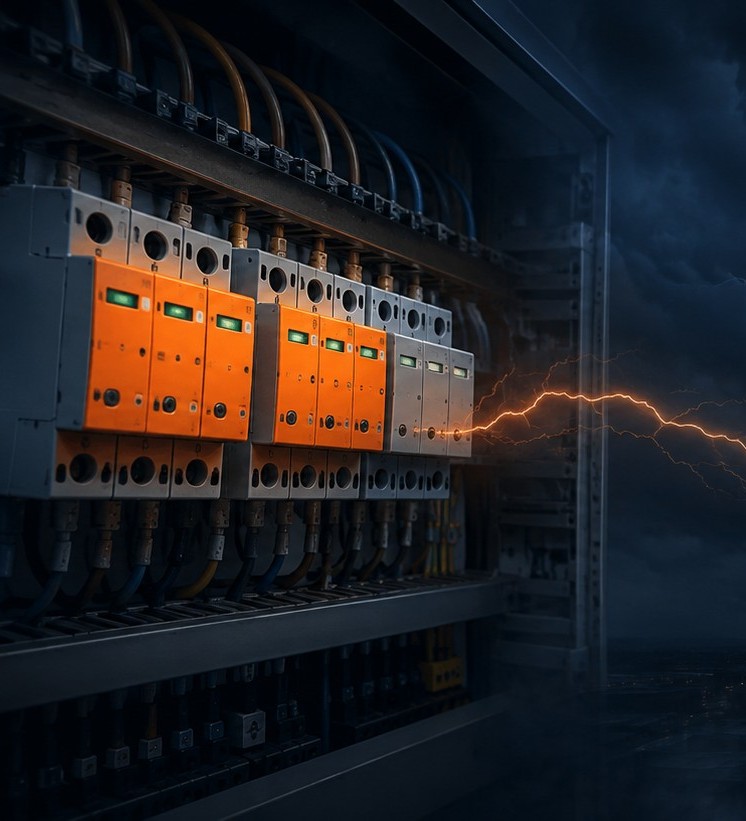
Type 1 AG surge protectors must be used on AC and DC lines. Surge protectors should have spark gap properties and be selected based on location-specific risk analysis.
- Protection Against Sudden Overvoltage Surges
- VDE 0100-443 (2007): Explains protection against overvoltage and lightning surges, including magnetic effects of cloud-to-ground strikes.
- VDE 0100-534 (2009): Explains selection, coordination, and design of surge protection systems.
Type 2 and Type 3 products should be used to protect energy, data, and communication modules in PV plants. Cameras and LED systems on-site should also be protected with these devices.

Photovoltaic: VDE 0100-712:2006 (IEC 60364-7-712:2002): Standards emphasize the protection requirements of photovoltaic systems.
- In addition to protection measures, grounding and equipotential bonding are essential on-site.
- AG Surge Protectors should be used to reduce induced currents on DC lines, avoiding large conductive loops and using shielded cables.
- Type 1+2 AG Surge Protectors should be used at inverter DC inputs and AC outputs.
- After external grounding in external lightning protection design, spark gap suppressors should be used for equipotential bonding.
- The required protection distance must be maintained between lightning conductors, capture rods, and cables.
- Panel transitions must use isolated lightning conductors, especially on rooftops; isolated conductors should be used for down-conductors.
- Cable cross-sections in surge protector connections must be sufficient; 16 mm² cables are recommended.
As Lightning Protection Center, we continue to inform investors and EPC companies to ensure sustainable investments. Yılkomer provides project planning, risk analysis, product selection and design, implementation, and reporting for solar systems. Many plants have been protected using anti-corrosive products with a 20-year lifespan. You can always contact us at info@yilkomer.com.