What is Touch Voltage?
Touch voltage is the portion of the grounding voltage that can be bridged by a human. In this case, the current path through the human body is from hand to foot (horizontal distance to touchable point approximately 1 m) or from hand to hand.

Touch voltage
- E: Grounding electrode
- S1, S2, S3: Potential equalizing electrodes connected to the main grounding electrode
- UE: Grounding voltage
- USS: Possible step voltage
- UST: Maximum possible touch voltage
- UTST: Maximum transferred touch voltage, if the sheath is not grounded at the farthest point
- UTSTE: Maximum transferred touch voltage, if the sheath is grounded at the farthest point
You may be interested in: Step Voltage Calculation
For low voltage, the permissible touch voltage UL should not exceed 50 V. In construction sites, agricultural areas, and similar locations, this value is set to 25 V. Since human body resistance and the position and condition of touch points vary from person to person, current-based calculations are not practical. Therefore, hazard limits are defined according to touch voltage and duration. Further information on touch voltage and body current is available in Grounding Regulations in Electrical Installations, Appendix C.
Example Touch Voltage Calculation
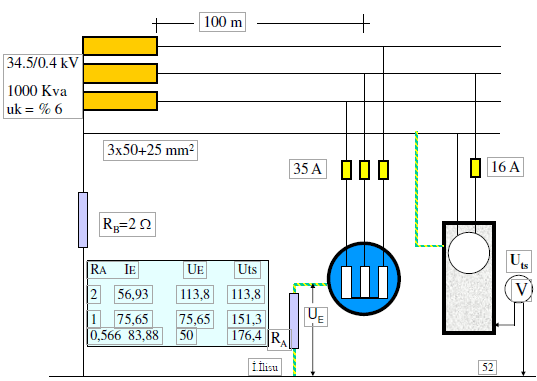
Example touch voltage calculation
Transformer reactance Xtr = (6/100) × 0.4 × 0.4 / 1 = 0.0096 Ω
Rh = (56/50) × 100 = 0.04 Ω, Xh = 8.478 Ω
Resistance and reactance of the network up to the grounded consumer:
Total resistance in the fault current path:
Ztotal = RA + 2.04 Ω
If RA is selected so that the touch voltage does not exceed the safety limit of 50 V under fault, then 230 – 50 = 180 V. Current: 180 / 2.04 = 88.23 A. Therefore, RA = 50 / 88.23 = 0.566 Ω.