Lightning and Surge Protection Sector Evaluation
2 February 2015
Protection of LED Lighting Against Lightning and Surge
11 February 2015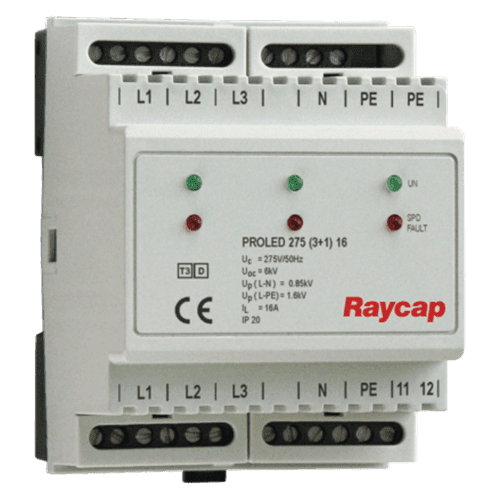
100 million km/h speed, 1 billion volts, 200 thousand amperes of current, 28,000 °C temperature, and light waves striking the Earth 8 million times every day. The characteristics mentioned above belong to Lightning, the most frequently occurring yet least understood natural phenomenon on Earth. As a result of such powerful energy reaching the ground within microseconds, every year approximately 100 million electronic devices are damaged worldwide, causing billions of euros in losses. Therefore, this natural phenomenon is definitely a condition that requires preventive measures. When evaluated on the 10/350 waveform, lightning is an impulse that reaches its peak value in 10 microseconds and decays within 350 microseconds. Switching elements, harmonics, voltage rises, and voltage drops, which affect our daily lives and electronic systems five times more than lightning, have an 8/20 waveform characteristic, meaning they reach maximum value in 8 microseconds and decay within 20 microseconds. These two types of impulses are absolute threats that must be considered during the design and engineering stages of our systems. Because statistical data shows that systems suffer damage from short-duration voltage impulses at a much higher rate compared to all other disasters.
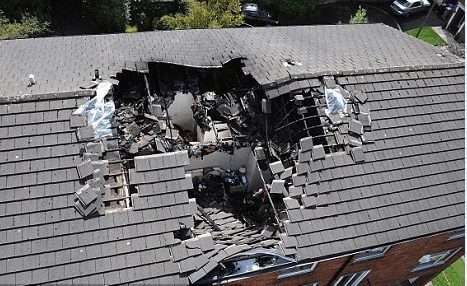
Every year, 240,000 people are injured due to lightning strikes.
With the development of modern technology, Smart Buildings are becoming increasingly widespread. As a result of home automation, the systems in these highly comfortable structures contain very sensitive circuit designs. In general terms, many Smart Buildings are also very tall structures; conversely, many skyscrapers are automation marvels. Almost every building includes an external lightning protection system (lightning rod–Faraday cage). However, the probability of lightning attraction in such tall structures is higher compared to surrounding smaller buildings. Considering the risk of damage to electronic devices due to coupling effects within a 2 km radius from the strike point, it can be stated that all home automation systems are constantly under risk, regardless of building size—although high-rise buildings inevitably face a greater risk.

Protection of a building with an external lightning protection system
Basically, the systems required to protect a structure against lightning and other impulses are as follows;
1- External Lightning Protection Systems: Protect human life and against fire.
2- Internal Lightning Protection Systems: Protect electronic systems and devices against impulses and prevent fires in panels.
3- Grounding: The most critical point of the system.
4- Equipotential Bonding System: Must be ensured at every point for safe protection.
If we want to protect our systems against lightning and other impulses, these four systems are indispensable. Unfortunately, in many buildings in our country, only external lightning protection—especially lightning rod systems—is considered sufficient. However, 50% of a 200 kA lightning discharge attracted by a lightning rod is dissipated by the ground, while the remaining impulse jumps into electrical systems within a 2 km radius due to equipotential differences in microseconds. Such short-duration impulses are not detected by fuses or relays and cause permanent damage to systems. Therefore, INTERNAL LIGHTNING PROTECTION – SURGE ARRESTER systems are absolutely essential. Besides lightning discharges, 65% of impulses affecting electronic systems originate internally. These short-duration impulses occur due to switching elements and many other reasons and must be protected against. Protection against lightning and grid impulses is achieved with different products, but both systems work in integration.

Basically, an internal lightning protection system should be designed with stepped protection products: Class B (main panel – 10/350 waveform), Class C (sub panel – 8/20 waveform), and Class D (8/20 waveform). These products are available in approximately 1,500 different types. Expert engineering support is crucial in product selection, as incorrect product use will not protect systems.
The causes of surge impulses include lightning strikes, switching impulses, transient voltage fluctuations, harmonics, and voltage drops. The main difference of these impulses is their short duration. For this reason, internal lightning protection systems are required. The fact that fuses and relays only react to long-duration impulses proves the necessity of having internal lightning protection devices in every panel, similar to fuses.
In cases where lightning strikes external lightning protection installations or low-voltage overhead lines directly, the high energy level of lightning voltage usually causes connected loads to fail and insulation damage. Induced voltage increases in building installations and power or data lines may reach several times the nominal operating voltage.
Surges caused by switching operations do not generate voltage increases as high as lightning discharges, but they occur very frequently and can cause system failures. Switching surges may raise the operating voltage two to three times, while lightning voltage can reach twenty times the nominal voltage and carry massive energy. Failures often occur later, as electronic components age over time due to damage caused by smaller transient voltages.

Transient voltage fluctuations are short-duration voltages occurring in the microsecond range but can reach very high amplitude levels compared to nominal voltage!
Our recommendation is to immediately check whether surge protection devices exist in the building you are in or responsible for and take action to install the system.
Control Units, Lighting Systems, Socket Systems, Sensors, Remote Control Units, Cameras, Shutter Control Systems, Thermostats, Z-wave control systems are the core systems used in Smart Buildings. Due to their sensitive structures, all of them can be damaged at any moment and, most importantly, may cause serious fires due to sudden sparks. Therefore, using internal lightning protection systems together with these systems should be considered not just a recommendation but a necessity. However, many companies exclude these systems from their offers to avoid increased costs and competitive disadvantages. Ensuring these products are used within a standard framework is our duty as engineers.