
What Is a Faraday Cage?
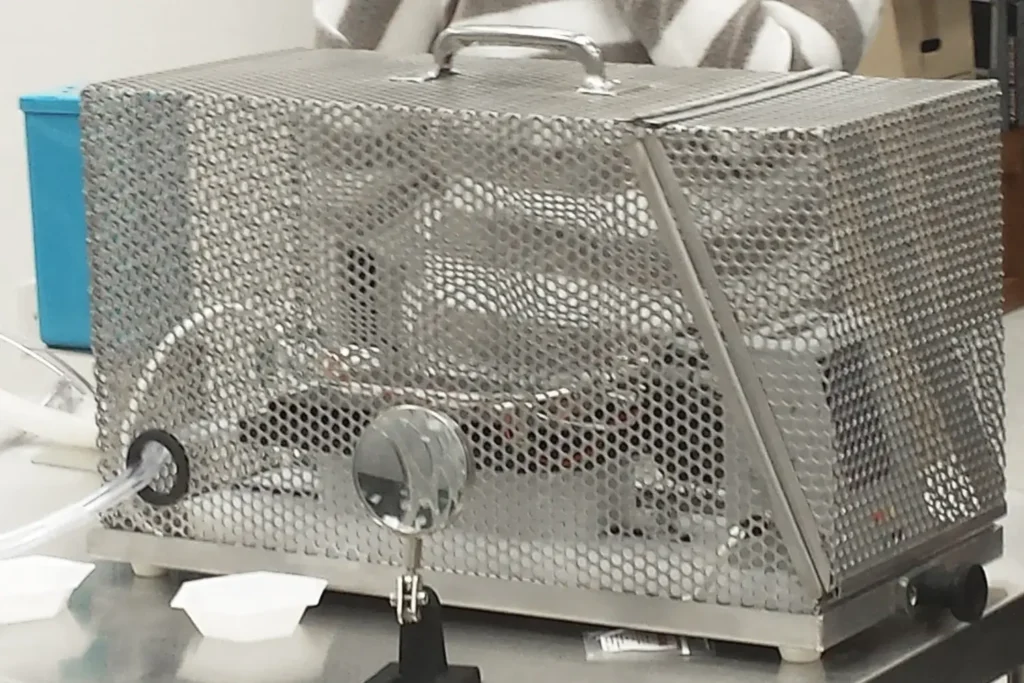
A Faraday cage is an enclosure used to block electromagnetic fields. It protects objects inside from both static and non-static electromagnetic fields. By distributing electrostatic charge outward, it prevents objects inside from being affected by electromagnetic radiation. An external electrical shock passes harmlessly along the outer surface of the cage.
Working Principle of the Faraday Cage
A Faraday cage operates based on the principle of electromagnetic shielding. When an external electric field is applied to the cage, free electrons redistribute along the conductive materials due to electrostatic induction. This means the cage creates an electric field opposite to the external field. As a result, objects inside the cage are protected from external electromagnetic fields.
History of the Faraday Cage
Michael Faraday is considered one of the most important scientists of the 19th century. Although he began his career as a chemist, he demonstrated the relationship between chemical bonding and electricity and discovered the effect of magnetism on light. Faraday tested his theory by allowing high-voltage discharges from an electrostatic generator to strike the outside of a metal-foil-covered area. This experiment formed the basis of the Faraday cage.
Who Invented the Faraday Cage?
The Faraday cage takes its name from its inventor, Michael Faraday. Faraday succeeded in creating a shield capable of neutralizing the effects of electromagnetic fields on objects inside it.

Where Is the Faraday Cage Used in Daily Life?
Faraday cages are used in many different ways in daily life. For example, the metal frame of automobiles acts as a Faraday cage and protects passengers from lightning. Microwave ovens also function as a type of Faraday cage, preventing waves inside from leaking out. In addition, Faraday cages are used to protect electronic devices from electromagnetic radiation.
One of the most well-known applications of the Faraday cage is lightning protection for buildings. In this application, a conductive mesh is placed around the building using the Faraday cage principle. This mesh disperses the effect of lightning and protects the building and its occupants.
Another example is the use of Faraday cages in laboratories where sensitive measurements are required. These cages protect the laboratory environment from external electromagnetic interference, enabling more precise and accurate measurements.

Construction of a Faraday Cage
A Faraday cage can be easily constructed using conductive sheets and tapes made of materials such as copper or aluminum. Grounding provides protection against electrostatic discharge currents and is therefore an important step in building a Faraday cage.
Do Faraday Cages Protect Aircraft from Lightning?
Yes, aircraft are protected from lightning thanks to their metal frames. Electricity is distributed along the metal structure of the aircraft, keeping passengers and equipment safe.
Areas of Use of the Faraday Cage
The Faraday cage is used across a wide range of technologies to block electromagnetic radiation. It is used in many fields, from lightning protection to the healthcare sector, from the automotive industry to homes and laboratories.
The Faraday cage is an effective tool for controlling and blocking electromagnetic waves. Whether to protect a building from lightning or to perform sensitive measurements, when properly designed and used, a Faraday cage provides effective protection. Therefore, understanding how a Faraday cage works and when and how to use it is important for protection against the potential harms of electromagnetic waves.
Relationship Between the Faraday Cage and Lightning Protection Systems
The Faraday cage is closely related to lightning rod technology. Benjamin Franklin, the inventor of the lightning rod, discovered that electrical charge remains only on the surface by suspending a charged cork ball inside a silver box charged with electricity. Faraday further developed this observation by demonstrating that electrostatic charge remains only on the outer surface of a conductor.
However, the lightning protection system defined in the current IEC 62305 standard and the Faraday cage described above are not the same concepts. In our country, the term Faraday cage has come to be used as a lightning protection system. However, there is no concept called a Faraday cage in the standard. Passive air terminals, mesh methods made with bare conductors, and lightning down conductors descending openly along the building surface are collectively referred to as Faraday in our country. However, this concept is a mixture of the protection angle method and the mesh method. A Faraday cage actually refers to a protection system designed primarily to shield against magnetic fields. Therefore, the rolling sphere method, mesh method, protection angle method, and catenary wire method are the fundamental lightning protection systems defined in the standard.
As Yılkomer, we apply the methods specified in the IEC 62305 standard to protect your facility from lightning. We can also prepare a preliminary design and recommend the correct system for your projects. For questions and projects within this scope, you can contact us at info@yilkomer.com.
Remember, Yılkomer ‘Protects Your Values!’