How Do SPDs Work?
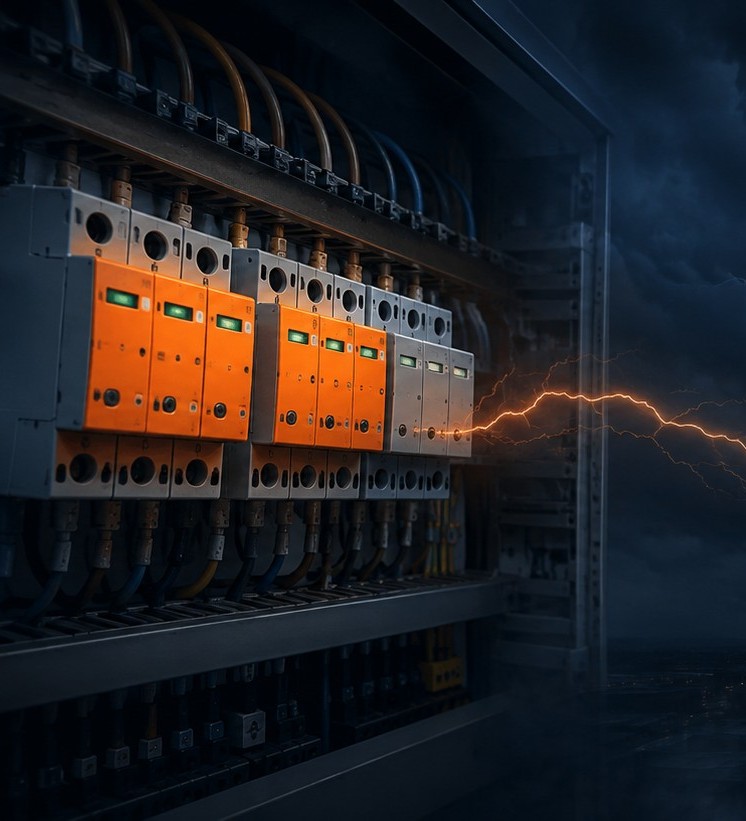
When a sudden voltage occurs in the protected circuit, SPDs limit the transient voltage and divert the current to its source or to ground. For this purpose, at least one nonlinear component is required. This component switches between high and low impedance states under different conditions.

Under normal operating voltages, SPDs do not affect the system as they remain in a high-impedance state. However, when a sudden voltage occurs in the circuit, the SPD switches to a conductive state and reduces the voltage to a safer level by diverting the surge current to its source or to ground. After the transient event is diverted, the SPD automatically returns to the high-impedance state.
SPD Categories or Types
There are two main types of SPDs: voltage-limiting components and voltage-switching components. Voltage-limiting components limit transient voltage by changing their impedance as the voltage increases. Voltage-switching components, on the other hand, “turn on” when a threshold voltage is exceeded and immediately switch to a low-impedance state. Today, most systems use a combination of both component types by combining their strengths and limiting their weaknesses.

Voltage-limiting components include metal oxide varistors (MOVs) and transient voltage suppression (TVS) diodes. Voltage-switching components include gas discharge tubes (GDTs) and spark gaps.
Comparison of SPD Categories
Surge components can be compared in terms of performance according to the following factors.
- Response Time: The response time of a component refers to how quickly it reacts when the surge threshold is exceeded. TVS diodes, in particular, have faster response times than voltage-switching components (such as spark gaps and GDTs).
- Follow Current: This condition is limited in voltage-switching devices. Follow current occurs when the surge protection device does not “turn off” (i.e., does not return to a high-impedance state) after a transient event. This allows current to continue flowing through the device during normal operation. This phenomenon is less of a concern in AC systems, as the zero crossing allows the component to turn off and return to a high-impedance state. However, it must be given greater consideration in DC systems using voltage-switching devices.
- Let-Through Voltage: During a surge event, the let-through voltage is the amount of voltage allowed to reach the connected equipment. Diodes limit voltage very effectively and keep it low; however, this advantage is limited because diodes are not as effective at handling larger surge currents.
A component not mentioned above that is neither the best nor the worst in all three areas is the MOV, as MOVs are generally considered usable in all categories, meaning they are not the best in any single one.
Note: Most SPD products available on the market today are hybrid designs that combine multiple surge components. These products balance the advantages and disadvantages of each component and provide balanced protection against various types of surges.

Key Parameters of Surge Arresters
The performance characteristics or ratings that maintain SPD standards should be used to compare different available devices after determining the required power distribution system for the SPD.
- Maximum Continuous Operating Voltage (MCOV). MCOV is the maximum voltage that the device can withstand while continuing to operate correctly. Generally, MCOV should be at least 25% above the nominal supply voltage, as defined by the relevant standards. For example, Raycap surge arresters are manufactured to withstand operating voltages up to 125% of grid voltages.
- Voltage Protection Rating (VPR) or Voltage Protection Level (Up). The voltage protection rating and voltage protection level are ratings defined by UL and IEC, respectively, that indicate the let-through voltage of the device. UL 1449 includes a test that applies a 6kV/3kA combination wave to the device and measures the let-through voltage, determining the VPR. IEC 61643-11 has a similar test, referred to as the voltage protection level (Up).
- Nominal Discharge Current (In) Rating. This is the peak value of the current that the SPD can conduct according to an 8/20μs waveform and is specified when the SPD remains functional after 15 applied surges. According to UL 1449, manufacturers must select a predefined nominal discharge current for this test (3kA, 5kA, 10kA, or 20kA).
- Status Indication. The status indicator may be a mechanical indicator with a simple open-closed contact, an LED, or a remote alarm.
- Surge Current Capacity or Maximum Surge Rating. Manufacturers often list these ratings (if any) as indicators, as they refer to the lifetime durability of the device or its ability to withstand a single maximum surge current. Although these ratings appear on many manufacturers’ websites and datasheets, UL or IEEE do not define them. This allows each manufacturer to establish its own test requirements (if any), making them less reliable indicators of performance.

SPD Classes or Types
SPDs are classified by standards as type (UL) or test class (IEC). Specific test conditions are defined for each type and test class to evaluate and ensure proper operation in different locations and installations. The recommended test class or SPD type is determined by considering the magnitude of large surge currents at the installation and how sensitive the protected load is to limiting let-through voltage.
The image below shows the classifications and categories of SPDs according to ANSI/IEEE C62.41, IEC 61643-11, and VDE classification.

Class B (Class 1 – Type 1) Surge Arresters
If a building or an area within approximately 50 meters of the building has a lightning protection system, a Type 1 surge arrester should be selected. These surge arresters are used at the closest point where the supply line enters the building in low voltage installations. They are the class of surge arresters that protect against lightning and should be installed before the electricity meter.
Class C (Class 2 – Type 2) Surge Arresters
To protect against internally generated transient overvoltages, “Type 2” surge arresters should be installed additionally in each distribution panel of the installation. These surge arresters are used as overvoltage limiters in low voltage installations and should be installed after the electricity meter.
Class D (Class 3 – Type 3) Surge Arresters
These are surge arresters used to protect sensitive electronic devices in low voltage installations. If the distance to the distribution panel containing the Type 2 surge arrester exceeds 30 meters, Type 3 surge arresters should be additionally used. These surge arresters respond quickly, have low Up protection levels, and provide protection according to the 8/20 waveform.

Class B+C (Class 1+2 – Type 1+2) Surge Arresters
This is a combination of Type 1 and Type 2 surge arresters. It is recommended when the distance between the main distribution panel and sub-distribution panels exceeds 10 meters. These surge arresters provide protection against both lightning surges and grid-originated transient overvoltages.