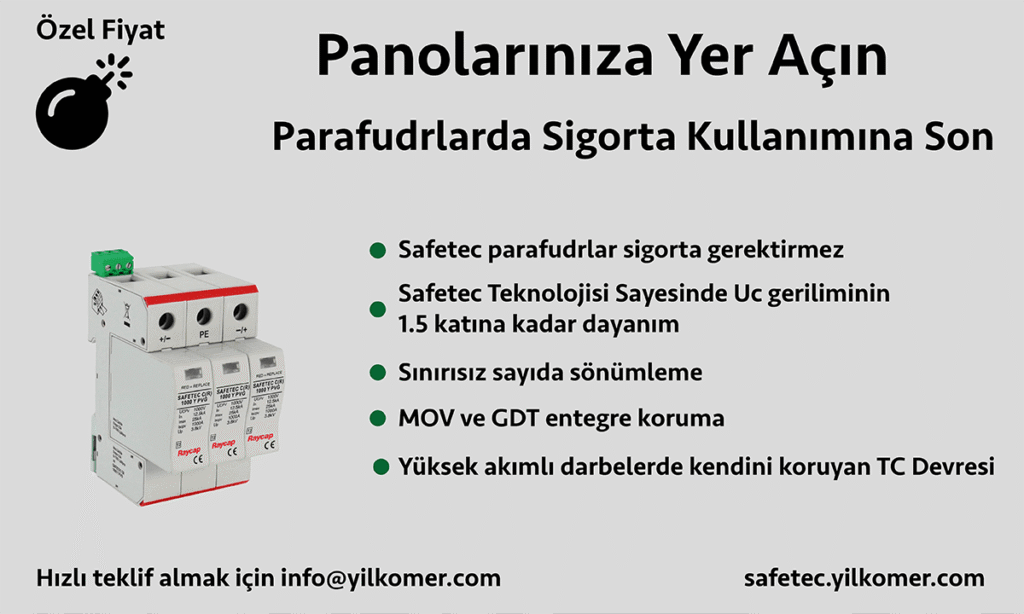
The patented Safetec technology developed by the German company Raycap-Iskra-Zascite puts an end to the use of fuses in LV surge arresters.

One of the problems frequently encountered with surge arresters on the market is that due to the long distance between the MOV and the disconnector, when a heat increase occurs in the surge arrester, it is detected very slowly by the MOV. In Safetec technology, the electrodes are soldered onto the MOV. Therefore, voltage up to 1.5 times the Uc voltage can be applied directly to the surge arrester.
However, there is a physical barrier between the MOV and the electrodes. The existing rotating disk reacts in less than 1 second, ensuring the safe disconnection of the MOV from the system in the surge arrester. Thus, the MOV is protected when an excessive impulse or energy comes to the surge arrester. In addition, this physical barrier prevents the arc event that occurs especially in DC surge arresters.

You can understand the patented Safetec technology much better from the image below. You can see the gas discharge tube, current limiter, and MOV. When an impulse comes, it is first dampened by the GDT. The current limiter prevents the MOV from being damaged in strong impulses. Thus, the surge arrester works healthily for a much longer time.