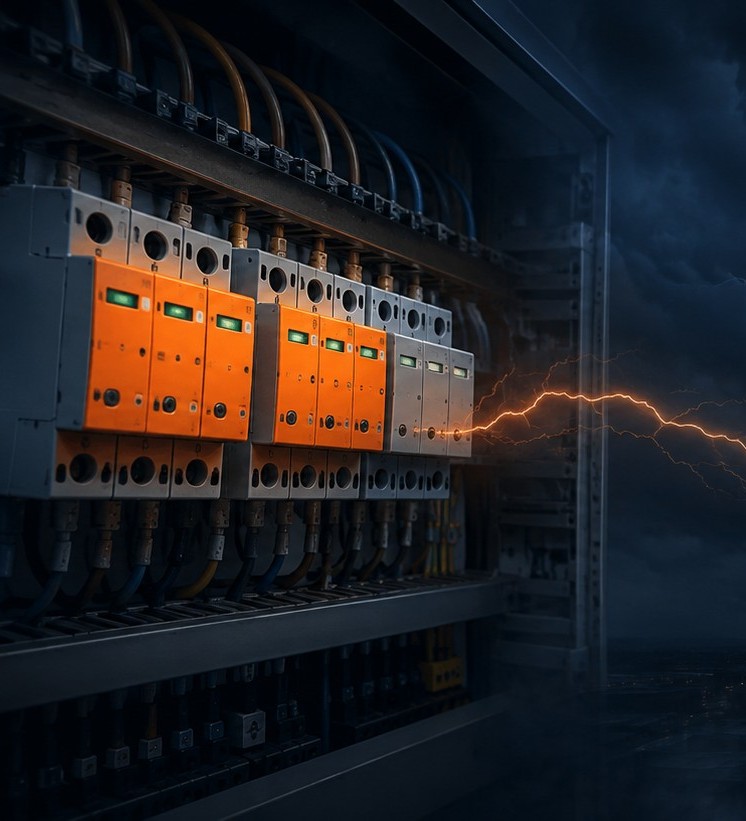
Having a surge protector system inside the panel will protect all system components, especially the RCD, against lightning and sudden overvoltage surges from the grid. Proper product installation will lead to the protection of all panel components. Since the RCD directly affects human safety, it is crucial that it is not damaged by strong surges such as lightning. Therefore, the surge protector and RCD must always be used together in the same system. Here, the main issue is this: while protecting the RCD from lightning and overvoltage surges, how can the RCD safely protect us from leakage currents?

When a Type 1 or Type 2 surge protector is installed in your panel, the surge is discharged to the ground via the PE conductor. This can be detected as a leakage current by the RCD and may trip the device. On the other hand, incoming lightning surges could mechanically damage the RCD. To prevent this, Type 1 or 2 surge protectors must be connected before the RCD.
Example of TN-C-S Surge Protector and RCD Usage
In the image below, you can see how Class B and Class C surge protectors are used for TN-C-S networks. Class D surge protectors are connected to the output of the RCD. Even if a surge occurs between L-N, the Class D surge protector will protect us. Since surges between L-N are suppressed, there will be no discharge to the PE conductor, preventing the RCD from tripping as described above. In other cases, even with Type 1 and Type 2 surge protectors, incoming surges could reach a level that would damage our RCD. Class D surge protectors provide the necessary protection with a low Up level.