In recent years, it is an undeniable fact that our country has made a major breakthrough, especially in the construction sector. Many prestigious projects are rising across the country, particularly in Istanbul. Newly developed concept projects also attract attention with the many opportunities they offer. The location of the project, its social facilities, and the advantages it provides are promoted across all platforms by project owners, and these projects find buyers worth thousands of liras. However, under these circumstances, there are many technical issues within projects that investors and buyers cannot fully understand. Surge and lightning protection is one of the most critical among these topics.
As an institution that has been closely involved in this field for many years, we encounter deficiencies in implementation and design even in the most prestigious and comprehensive projects. Many companies and engineers undoubtedly perform their work properly. However, due to the traditional perception of lightning protection in our country and deficiencies in regulations, unfortunately many projects carry risks against surge and lightning impulses.
The TS EN 62305-1-2-3-4 standard defines the criteria for lightning protection systems in our country. Fundamentally, this standard emphasizes the importance of Faraday cage and internal lightning protection systems.
In our facilities, in addition to the external lightning protection system, we must absolutely install internal lightning protection systems in our panels. Unfortunately, many projects are incorrectly protected with incomplete external lightning protection systems, and surge arrester products are used in very few projects.
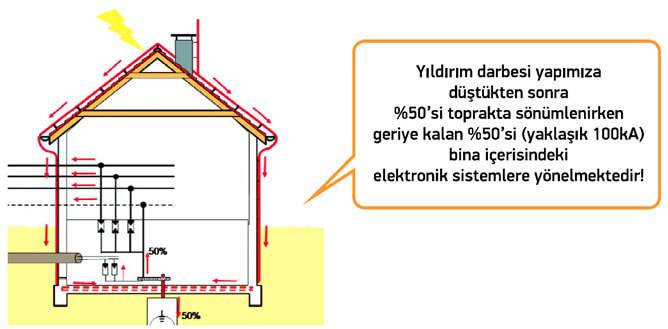
- Ensuring insulation of down conductors and conductors at risky points in Faraday cage systems
- If insulated cables resistant to lightning impulses (isCon) are not used, maintaining the ‘S’ separation distance specified in the TSE EN 62305 standard
- Ensuring that the thickness of the products used is selected according to the TSE EN 50164 standard is one of the most critical points
- When lightning strikes, it creates a magnetic field, and due to the impulse characteristic, surges may be induced into our facility through parallel lines; therefore, isolating the impulse as much as possible is extremely important
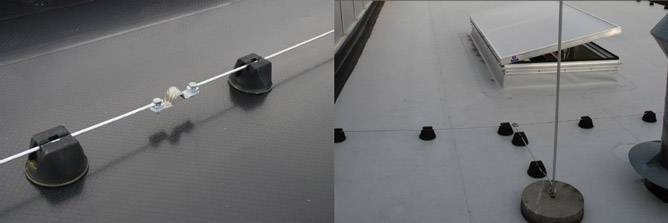
In systems designed according to the rolling sphere method, the coordination of the radius and the position of the air terminals is the most critical point of the entire project. In both systems, correct grounding, the use of exothermic welding, the availability of bimetal products where required, and the application of corrosion tape are of great importance.
The most critical aspect at the grounding point is taking precautions against step voltage. If precautions are not taken at the grounding initiation point with copper meshes and a safety perimeter is not implemented, it may lead to people being exposed to electric current in the future. Indeed, this frequently neglected issue in many residential projects poses a serious danger. In external lightning protection systems, it must be ensured that the voltage is safely conducted and discharged, and the use of spark gap connection devices at grounding points is vital for both human life and electronic system safety.
Internal lightning protection systems ensure the safety of electronic systems against lightning and surge. Incoming impulses to the facility can damage all devices, and it should not be forgotten that buildings equipped with external lightning protection systems must also include internal lightning protection systems. Internal lightning protection systems are classified as Class B, Class C, Class B+C, and Class D.
Class B, C and B+C systems are panel protections connected in parallel, while Class D systems are installed in series in front of devices. Class B provides protection against lightning, while Class C and D protect against other impulse types. In panel connections, minimum cable cross-sections of 16 mm² for Class B, 6 mm² for Class C, and 1.5 mm² for Class D must be used, and grounding type must be considered when selecting products.

TT, TN-S, TN-C differentiated ground–neutral configurations are important in product selection. When connecting surge arresters, V-connection and minimizing cable length are essential. The grounding conductor should not circulate excessively inside the panel and must be routed to the grounding bar via the shortest path for system safety. When necessary, surge arresters can also be integrated into the system via a separate panel under the name LVSPD. Only spark gap technology products should be connected before meters; using varistor-based products before meters is hazardous.

Measurements performed before and after the installation of lightning protection systems are mandatory to ensure correct implementation. Our goal is to direct impulses under our control, and therefore resistance values to be obtained are defined by standards. Additionally, measurements conducted to ensure the equipotential system are equally important. An equipotential difference above 0.2 ohms within a facility poses a risk. All grounding systems, including lightning protection systems, must be collected via local equipotential bars and connected to the main equipotential bar to ensure resistance equality. However, once this process is performed, surge arresters must absolutely be used.
- Strips must be selected with a thickness of 70 microns
- Exothermic welding must be applied
- Connection equipment thickness must not be below 3 mm
- Corrosion tape must be used
- Strip extensions must be routed outside the building from mesh system corners
- Perfect bonding with reinforcement steel must be ensured
Attention by expert teams to mesh density and symmetry will increase the building’s safety factor.
In conclusion, application engineering is extremely important in lightning protection and grounding systems. Performing this work by expert companies is critical for safety.